

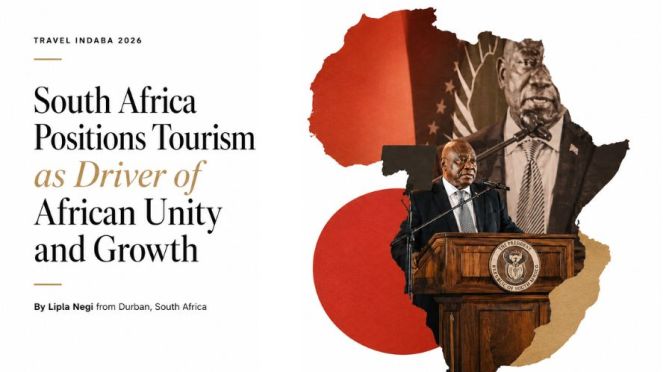
Durban once again became the meeting point of African tourism leaders, policymakers and global travel stakeholders as South Africa officially opened Africa’s Travel Indaba 2026 with a strong message of continental unity, economic growth and cultural pride.
Lipla Negi from Durban, South Africa
Welcoming delegates to the coastal city, President Cyril Ramaphosa described Durban as “a city that embodies the spirit of African hospitality” and “where cultures meet and where Africa gathers once again to tell its tourism story.”
 Addressing ministers, tourism authorities, exhibitors and media representatives from across the continent, the President said the occasion was marked by pride in the resilience of the tourism sector and the partnerships that sustained the industry through some of its most difficult years.
“Tourism is more than a sector of the economy,” he said. “It is a living expression of who we are as a people.”
South Africa recorded 10.5 million international arrivals last year, a figure President Ramaphosa said reflected renewed global enthusiasm for the country. Notably, nearly three-quarters of those visitors came from the Southern African Development Community (SADC) region.
“This tells us something important: Africans are choosing Africa,” the President said.
 He highlighted ongoing efforts to advance the SADC Tourism UNIVISA initiative, aimed at enabling seamless cross-border travel across member states. South Africa is also expanding one-stop border posts and developing regional tourism itineraries to encourage intra-African travel.
“When Africans travel within Africa, we strengthen our economies, deepen our cultural ties and build a more integrated continent,” he said.
The President linked tourism development to South Africa’s broader cultural identity, recalling his call during the State of the Nation Address to promote “unique cultural, historical and natural attractions that reflect the country’s identity.”
Among the country’s recent tourism investments is the upgraded Cape Agulhas Lighthouse precinct at the southernmost tip of Africa, where the Indian and Atlantic oceans meet. He also referenced the Kgodumodumo Dinosaur Interpretation Centre in the Free State’s Golden Highlands National Park, which has attracted more than 88,000 visitors since opening in 2025.
 Durban itself has expanded its tourism offering with the unveiling of statues honouring anti-apartheid icons Nelson Mandela and Oliver Tambo.
According to the President, tourism growth is not merely reflected in statistics but in livelihoods and community upliftment.
“They represent families supported, small businesses revived and communities that are being uplifted,” he said.
Citing data from Statistics South Africa, Ramaphosa noted that tourism supports nearly one million direct jobs in the country, with approximately one in every 18 workers employed in the sector.
Africa’s Travel Indaba, one of the continent’s largest tourism trade platforms, continues to play a major role in regional economic activity. Last year’s event attracted around 10,000 delegates and over 1,300 exhibitors.
“The benefits are felt not only in boardrooms but also in small businesses, township enterprises and the homes of ordinary South Africans,” the President said.
He also reflected on South Africa hosting the first-ever G20 Leaders’ Summit on African soil, describing it as “a declaration that Africa is ready to shape global conversations.”
 During South Africa’s G20 Presidency, the country championed issues including sustainable tourism, infrastructure investment and equitable growth. The period also saw the piloting of the Electronic Travel Authorisation system, now being rolled out to simplify travel procedures for international visitors.
Tourism connectivity, Ramaphosa stressed, remains critical for Africa’s future. Increased airline seat capacity on African and Asian routes over the past year signals growing demand for travel to the region.
“These developments are part of a broader continental movement, a recognition that Africa’s future lies in being connected to itself and to the world,” he said.
South Africa is now strengthening tourism ties with emerging markets, including China, India, Southeast Asia, Mexico and Brazil, while new visa reforms such as the Digital Nomad Visa are expected to improve accessibility for international travellers.
With the event taking place during Africa Month, the President tied tourism to the wider goals of the African Union’s Agenda 2063 and the African Continental Free Trade Area.
“Pan-Africanism is not only a political philosophy,” he said. “It is a driver of economic progress. It is the foundation of our shared prosperity.”
 The speech also placed strong emphasis on the role of young Africans in shaping the future of tourism through innovation and entrepreneurship.
“It is about the young entrepreneur in Soweto who is building a digital platform for township experiences,” Ramaphosa said. “It is about the young innovators who are developing apps, safety tools and high-tech solutions that are reshaping the visitor experience.”
“Our youth are not waiting for the future. They are creating it now,” he added.
Closing his address, the President called for greater collaboration between governments, communities, industry leaders and young people to ensure tourism continues to drive opportunity across the continent.
“Africa is not waiting,” he declared. “Africa is leading.”

Rahul Bhadana is a digital editor at TravTalk with experience spanning multiple content niches, with a strong focus on travel trade journalism and digital publishing. A graduate of Delhi University, his work covers editorial writing, content strategy and platform-led storytelling, supporting TravTalk’s digital growth and industry engagement. A technology enthusiast, he enjoys films, poetry and exploring new ideas across media and culture.