
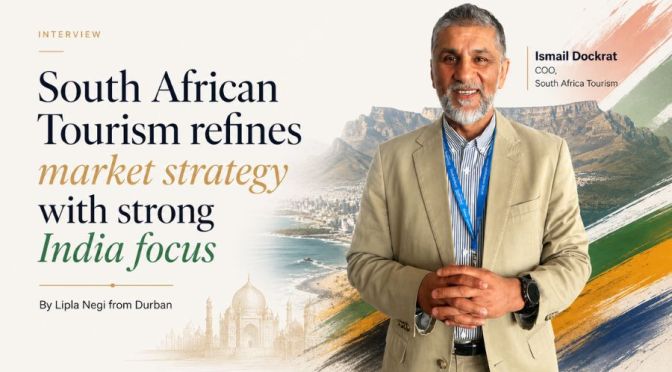
At Africa’s Travel Indaba 2026 in Durban, TRAVTALK spoke exclusively to Ismail Dockrat, COO of South African Tourism, on his new role, the India–South Africa cricketing connection, and strategies to sharpen destination marketing for today’s digitally savvy travellers.
LN
By
Lipla Negi from Durban
The International Convention Centre, Durban (ICC Durban) is buzzing with activity as Africa’s largest tourism trade show, Africa’s Travel Indaba 2026, takes centre stage, bringing together industry voices, ideas, and opportunities under one roof in the heart of the city. Organised by South African Tourism, the event convenes global buyers, African tourism exhibitors, and industry stakeholders to showcase the continent’s diverse travel offerings.
Just a week into his new role as COO, Ismail Dockrat is actively engaging with partners across the spectrum, making the most of the platform to connect with stakeholders and build momentum for South Africa’s tourism strategy going forward. He is focused on reshaping South African Tourism’s marketing approach and broadening the country’s global appeal by diversifying its offerings beyond wildlife, positioning South Africa as a more layered and contemporary travel destination.
India among top-tier source markets
He noted that South African Tourism is sharpening its focus on segmentation and niche positioning. “What’s interesting in all the conversations we have had is the intent to be much more niche and segmented about the types of tourists visiting us,” he explained. According to him, South Africa’s appeal spans a wide spectrum of traveller interests. “There’s something on offer for all types of tourists—families, multi-generational travellers, and those seeking specific experiences, whether it’s adventure, culture, history, shopping, or leisure and beach tourism. South Africa truly has so much to offer.”
India, a strategic market for South Africa, holds a key position among the country’s top-tier source markets. However, Dockrat is candid about the gaps that have existed in fully engaging Indian travellers. “I think, in terms of South African Tourism, we need to put the capacity in place within our structure for the Indian market,” said the COO. Acknowledging the shortfall, he added, “From my understanding, there has been a vacuum there, and we are now working to ensure that we fill that space.” He stressed that the immediate focus is on strengthening execution. “We are focused on creating the right capacity to take our marketing forward in that market.”
Ideal destination for big-ticket events
On MICE and destination weddings, South Africa’s infrastructure stands out as a key enabler, according to the COO, who pointed to the country’s established readiness to host large-scale global events. Highlighting the strength of the country’s events ecosystem, he said, “You will see that South Africa has got fantastic infrastructure to accommodate that.”
Referencing to ICC Durban and other major venues across key cities, he added, “This facility that we are in here is a very well-established convention centre. There is one in Johannesburg, one in Cape Town, and there are others around the country.” He stressed that capacity is not a constraint when it comes to hosting international gatherings. “Certainly, the infrastructure is there to accommodate those kinds of events. Access is good, telecommunications infrastructure is strong, and the capacity for the right kind of accommodation for these events is fantastic in our big cities.” He also underlined the strength of connectivity and urban mobility. “The transport networks are excellent. So there’s no challenge for us in being able to host big events,” he noted.
All eyes on Cricket World Cup 2027
Underscoring the deep sporting connection between India and South Africa, anchored strongly in cricket, Dockrat highlighted sports tourism as a key pillar in the country’s evolving travel strategy. “Sports tourism is going to be big,” he said, pointing to the upcoming Cricket World Cup as a major opportunity.
He stressed the importance of early and focused engagement. “We have got to have a great build-up in terms of the communication and the marketing that we do between now and the Cricket World Cup,” he noted. The strategy, he explained, will be highly targeted. “We have got to make sure we have a very focused approach towards those types of travellers who will be coming here for the Cricket World Cup 2027,” he underlined.
He also highlighted the regional dimension of the event, with matches hosted across multiple countries. “Namibia and Zimbabwe are also host countries. It’s going to be a great opportunity for us to expose tourists not just to South Africa, but also to neighbouring countries,” he shared. He added that this opens the door to broader regional tourism experiences. “There are fantastic attractions in Zimbabwe and Namibia that we need to make part of the route, part of the travel experience, so that visitors have a truly memorable journey while they are in our region,” he noted.

Rahul Bhadana is a digital editor at TravTalk with experience spanning multiple content niches, with a strong focus on travel trade journalism and digital publishing. A graduate of Delhi University, his work covers editorial writing, content strategy and platform-led storytelling, supporting TravTalk’s digital growth and industry engagement. A technology enthusiast, he enjoys films, poetry and exploring new ideas across media and culture.