

What is emerging clearly from Africa’s Travel Indaba 2026 is a shift in perception on both sides. For Africa, India is no longer a conventional source market defined only by safari demand. For Indian buyers, Africa is no longer a single-destination play.
LN
By
Lipla Negi from Durban
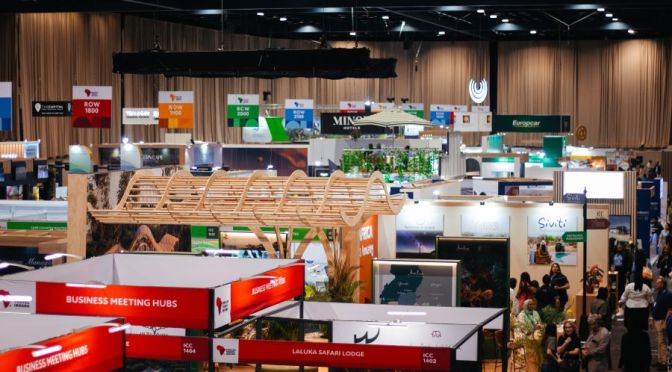
At Africa’s Travel Indaba 2026 in Durban, Indian travel trade buyers are discovering that Africa’s tourism narrative extends far beyond traditional wildlife itineraries. From experiential travel and adventure tourism to boutique stays, vineyards, destination weddings, and multi-country regional circuits across Southern Africa, the show is emerging as a key platform connecting Indian outbound travel planners directly with Africa’s evolving tourism ecosystem.
Organised by South African Tourism, Africa’s Travel Indaba was held at the International Convention Centre (ICC Durban). For Indian buyers, the event continues to be far more than a traditional contracting platform. It is increasingly becoming a strategic space to understand the preferences of the new-age Indian traveller and explore how Africa’s tourism offerings are evolving to meet those expectations.
 India’s evolving demand
For decades, South Africa’s strongest pull for Indian travellers has been wildlife and safari tourism. However, Indian buyers attending Indaba say traveller demand is rapidly diversifying.
Fenil Doshi, CEO of Gems Tours & Travels, who attended Indaba for the first time this year, believes the destination’s appeal today extends well beyond the traditional safari narrative.
“People still associate South Africa strongly with wildlife, especially experiences like Kruger National Park and private game reserves. But today’s traveller is also looking at adventure, activities, scenic landscapes, and climate-led travel experiences,” he said.
According to Doshi, Indian travellers are increasingly drawn towards adventure offerings such as skydiving and bungee jumping, alongside iconic natural attractions like Table Mountain and the Drakensberg mountain range.
He also pointed to South Africa’s seasonal advantage for the Indian market. “During India’s peak summer vacation period, South Africa offers a far more pleasant climate, which is becoming a major attraction for Indian families and leisure travellers,” he noted.
Exploring the regional tourism network
 One of the strongest takeaways for Indian buyers has been direct access to suppliers from across the African region, many of whom may otherwise remain inaccessible through conventional trade channels.
“The main advantage of Indaba is that you can reach out to very specific vendors you didn’t even know you needed. Whether it’s transport operators in Zambia and Zimbabwe, suppliers connected to the Victoria Falls region, or hotel partners without a strong online presence, they are all physically present here,” Doshi explained
He added that the event also offers credibility and reassurance. “These vendors have gone through multiple verification processes, which gives buyers confidence while building new business partnerships.”
For Priyank Savla, Founder, Red Rail Tours, the biggest differentiator was the ability to engage directly with activity owners rather than only wholesalers or tour operators. “Indaba is not just about South Africa, it’s about the whole of Africa. Back in India, we usually work with a limited supplier network. Here, I have e interacted directly with activity operators who explained the experiences in detail and shared insights we would not normally get at Indian trade events,” he shared.
For Savla, the conversations with tourism representatives from destinations such as Cape Town and Knysna offered highly personalised destination insights. “They sat with us for hours, helping us understand itineraries, experiences, sunset cruises, and local activities in depth. Sitting in India, you simply cannot get this level of interaction and destination understanding,” he said.
 Rise of the experiential Indian traveller
A recurring trend highlighted by Indian buyers at Indaba is the sharp rise of experiential travel demand among younger Indian travellers. Gauri Chhabra, COO, trawellsmith, noted that today’s travellers are moving away from rigid itineraries and standard sightseeing packages. “New-age travellers are looking for experiences rather than fixed itineraries. They want experiential stays, adrenaline-filled activities, and immersive travel moments,” she explained.
At Indaba, she discovered experiences ranging from crocodile dining concepts and luxury train stays to shark diving and vineyard tourism. “These are exactly the kinds of products that will appeal to younger Indian travellers looking for something different and memorable,” she added.
Multi-country itineraries gain ground
Indian travel planners also pointed to growing demand for multi-country African itineraries and experiential celebrations such as destination weddings.
Jovita Gandhi, Director – Marketing & Strategic Relations, Transglobal Holidays believes that Indian travellers are increasingly looking beyond traditional South African circuits. “Destinations like Zambia and Zimbabwe are generating strong interest among Indian travellers who want to explore newer experiences,” she shared.
According to Gandhi, discussions at Indaba have focused heavily on new tourism products being curated specifically for the Indian market. “We have been interacting with hotels, tourism boards, and adventure tourism operators to understand what’s new for Indian travellers. There is growing focus on adventure trails, experiential tourism, and even Indian weddings being hosted in South Africa,” she underlined.
Repositioning Africa for India’s next-gen traveller
For Africa’s tourism industry, Indaba 2026 is also serving as a listening platform, helping destinations better understand the expectations of India’s fast-evolving outbound market.
Indian buyers repeatedly emphasised that younger travellers today are seeking authenticity, flexibility, experiential travel, safety reassurance, adventure, and hyper-personalised itineraries. Clearly, the event has been successful in positioning the continent as a connected, experience-rich, and commercially expanding tourism ecosystem, one that is increasingly aligned with the expectations of India’s new-age traveller: experience-first, segment-driven, and open to discovery beyond the obvious.

Rahul Bhadana is a digital editor at TravTalk with experience spanning multiple content niches, with a strong focus on travel trade journalism and digital publishing. A graduate of Delhi University, his work covers editorial writing, content strategy and platform-led storytelling, supporting TravTalk’s digital growth and industry engagement. A technology enthusiast, he enjoys films, poetry and exploring new ideas across media and culture.