
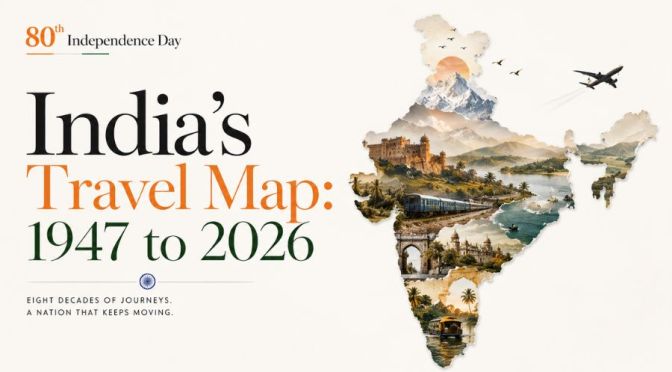
India’s travel map has never been static. In the years after Independence, travel was largely shaped by railways, roads, a small aviation network, and a handful of established destinations. Seven decades later, the map looks markedly different. Connectivity has widened, destinations have multiplied, domestic travel has become a powerful economic force, and the Indian traveller has moved from being a passenger on a journey to an increasingly discerning customer.
The transformation is not simply a story of more people travelling. It is a story of how India itself has become more accessible — and how the travel trade has evolved with it.
1947–1950s: Building the foundations
At Independence, India inherited a substantial railway network, but tourism as an organised economic activity was still in its infancy. The country’s enormous cultural, historical and natural attractions existed, but the infrastructure and institutional framework required to develop them systematically was only beginning to take shape.
The first steps came soon after Independence. A Tourist Traffic Committee was established in 1948, followed by a Tourist Traffic Branch in 1949. A separate Department of Tourism was created in 1958, signalling that tourism was beginning to be viewed as a distinct area of national development rather than simply an extension of transport or information services.
Railways were central to this early travel map. Indian Railways had 53,596 route kilometres in 1950–51, providing the backbone for movement across a country where air travel remained limited. By 2023–24, that network had grown to 69,181 route kilometres.
The destinations that emerged most strongly during this period reflected India’s established heritage and natural appeal — Delhi, Agra, Jaipur, Kashmir, Mumbai, Chennai, Kolkata and a growing selection of hill stations and beach destinations.
The travel map was beginning to take shape.
1960s–70s: Tourism becomes an industry
The next decades saw tourism move gradually from government-led promotion towards a broader ecosystem involving hotels, transport providers, tour operators and destination organisations.
The creation of India Tourism Development Corporation in 1966 added another institutional layer to the sector. Meanwhile, the growth of hotels and organised tours began to give international visitors a more structured way to experience India.
For the domestic traveller, however, the railway remained the great enabler. Long-distance rail journeys connected major cities with pilgrimage centres, hill stations, cultural destinations and emerging leisure markets.
This was also the period when the idea of travelling within India began to expand beyond necessity. Holidays, family travel and leisure journeys slowly became more visible components of domestic mobility.
1980s: The first tourism blueprint
The 1980s represented an important policy turning point. India’s first Tourism Policy was presented to Parliament in November 1982. It recognised tourism’s wider economic and social dimensions and called for better infrastructure, facilities and the development of tourism destinations and circuits.
The timing was significant. The 1982 Asian Games brought international attention to Delhi and created additional pressure for accommodation, transport and visitor infrastructure.
The idea of developing tourism circuits also began gaining prominence. Instead of treating destinations as isolated attractions, policymakers increasingly looked at combinations of places that could be marketed and accessed as a journey.
That approach would become familiar to the Indian travel trade in the decades that followed.
The map was no longer simply a collection of individual destinations. It was becoming a network.
1990s: Liberalisation changes the journey
If the 1980s established tourism as a policy priority, the 1990s changed the commercial environment around travel.
Economic liberalisation opened new possibilities for investment and business, while improvements in infrastructure and communications gradually made travel more accessible. The National Action Plan for Tourism in 1992 placed greater emphasis on tourism infrastructure, employment and attracting international visitors.
For the travel trade, this was an important transition. Tourism increasingly involved a wider private-sector ecosystem — hotels, tour operators, destination specialists, transport companies and emerging distribution channels.
The Indian traveller was also becoming more mobile.
The geography of aspiration was changing: foreign travel became more visible, domestic leisure markets expanded, and destinations outside the traditional Delhi–Agra–Jaipur and Mumbai–Goa corridors began attracting greater attention.
2000s: India gets a global tourism identity
The new millennium brought another major shift. The National Tourism Policy of 2002 positioned tourism as an engine of economic growth, emphasised domestic tourism, encouraged integrated tourism circuits, and recognised the role of the private sector in developing the industry.
Then came a campaign that changed the way India was presented to the world: Incredible India.
Destination marketing became more sophisticated, and India’s tourism proposition expanded beyond monuments and heritage. Wildlife, wellness, adventure, rural experiences, MICE, beaches and cultural experiences increasingly became part of the country’s tourism vocabulary.
At the same time, the travel trade was entering the digital age.
Online information and booking platforms began changing how travellers researched and purchased journeys. The traditional travel agent was no longer the sole gateway to travel information, but the trade itself was evolving, combining destination knowledge and human expertise with increasingly digital distribution.
India’s travel map was becoming both broader and more connected.
2010s: The traveller moves beyond the traditional map
The 2010s saw the biggest expansion yet in the number and variety of journeys available to Indian travellers.
Low-cost aviation, improving roads, new airports, digital booking and greater consumer choice helped reduce the distance between India’s major urban centres and its emerging destinations.
Tourism also became increasingly specialised.
A traveller could now build a journey around food, wellness, wildlife, adventure, photography, heritage, luxury, weddings or MICE rather than simply choosing a destination and buying a standard package.
This changed the role of the travel trade. Destination knowledge became more important, but so did personalisation, experience design and the ability to connect travellers with niche suppliers.
The map expanded into Tier 2 and Tier 3 cities, while destinations in the Northeast, the Himalayan states, coastal regions and lesser-known cultural centres gained greater visibility.
2020–2025: The map is redrawn
The pandemic temporarily brought India’s travel industry to a standstill. Borders closed, flights were grounded, hotels fell silent, and international tourism almost disappeared. Yet the disruption also accelerated changes that were already beginning to reshape the country’s travel map.
Domestic tourism became the industry’s immediate lifeline. As restrictions eased, travellers increasingly looked closer to home, with road trips, staycations, nature-based holidays, wellness breaks, and smaller destinations gaining prominence. For the travel trade, this created new opportunities beyond the established tourism centres.
The recovery also accelerated digital adoption. Travellers became more comfortable researching destinations, comparing options, making bookings, and managing journeys online. Travel businesses, meanwhile, increasingly combined technology with the expertise and personalisation offered by traditional travel professionals.
By 2024, India recorded 2,948.19 million domestic tourist visits, compared with 2,508.82 million in 2023. Foreign tourist visits stood at 20.94 million. The numbers reflected not only the return of travel but the sheer scale of India’s domestic tourism market.
At the same time, the destinations on the map continued to multiply. Tier 2 and Tier 3 cities, the Northeast, Himalayan states, coastal regions, wildlife destinations, spiritual centres, and lesser-known cultural locations increasingly entered the mainstream travel conversation.
The recovery, therefore, was not simply about returning to the pre-pandemic map. It was about redrawing it.
2026: A country still on the move
By 2026, India’s travel map is defined by a much wider range of destinations, travellers, experiences, and connectivity options than at any earlier point in the country’s modern tourism history.
The latest Ministry of Tourism data puts domestic tourism at more than 4.1 billion tourist visits in 2025, while international tourist arrivals reached 20.57 million in 2024. Tourism contributed 5.22% to India’s GDP and supported an estimated 84.63 million direct and indirect jobs in 2023–24.
But the significance of today’s travel map goes beyond the numbers.
New airports and improved regional connectivity are bringing more destinations within reach. Expressways are changing road journeys, rail connectivity continues to link major and emerging markets, and digital platforms are making it easier to discover and book experiences. At the same time, Indian travellers are becoming more selective about how they spend their time and money.
For the travel trade, this creates a market that is broader but also more sophisticated. Selling a destination is increasingly about selling the experience around it — from food and culture to wellness, adventure, luxury, MICE, wildlife, heritage, and community-based tourism.
The map is also becoming more distributed. Tourism is no longer concentrated only around India’s best-known gateways. Smaller cities and destinations are increasingly finding their place in itineraries, creating opportunities for local businesses, destination specialists, DMCs, tour operators, travel agents, and hospitality providers.
In 1947, India’s travel map was shaped largely by distance, infrastructure, and access. In 2026, as India celebrated its 80ᵗʰ is increasingly shaped by choice.
The next chapter may not simply be about adding more destinations to the map. It will be about connecting the destinations that already exist, creating stronger reasons to visit them, encouraging longer stays, and ensuring that more communities participate in the value created by tourism.
Seventy-nine years after Independence, India’s travel map is still being drawn. The difference is that today, the lines are being created not only by railways, roads, and airports, but also by technology, travel professionals, local experiences, and the changing ambitions of the Indian traveller.

Rahul Bhadana is a digital editor at TravTalk with experience spanning multiple content niches, with a strong focus on travel trade journalism and digital publishing. A graduate of Delhi University, his work covers editorial writing, content strategy and platform-led storytelling, supporting TravTalk’s digital growth and industry engagement. A technology enthusiast, he enjoys films, poetry and exploring new ideas across media and culture.