

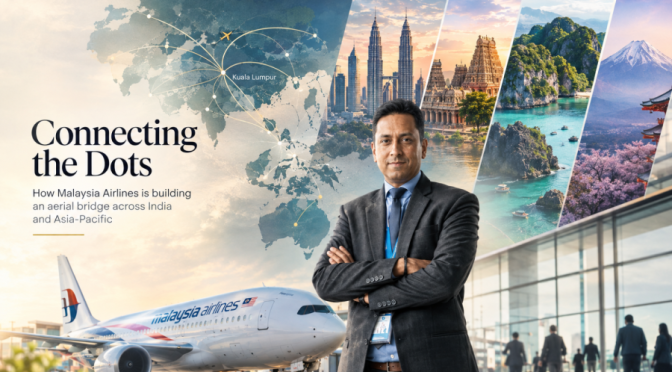
Across the bustling departure gates of India’s busiest aviation hubs, a quiet shift is taking place. Beyond traditional holiday trips to Southeast Asia, Indian travellers—from tech executives in Bengaluru to leisure seekers in Amritsar—are using Kuala Lumpur as a launchpad to explore Asia-Pacific and beyond.
At the center of this expanding web is Malaysia Airlines. Operating over 80 weekly flights across 10 Indian cities, the carrier has made India one of its most critical growth engines.
“India continues to be one of Malaysia Airlines’ key growth markets, with healthy demand across leisure, corporate and premium travel,” says Dersenish Aresandiran, Chief Commercial Officer of Airline Business at Malaysia Aviation Group (MAG). “This momentum is being supported by the continued growth of outbound travel from India, alongside strong demand for connectivity across Malaysia, Asia-Pacific and beyond.”
Beyond Metro Gateways: The Rise of Tier-2 Destinations
While major metros like Delhi, Mumbai, Bengaluru, Chennai, and Hyderabad continue to deliver robust passenger numbers, the real surprise lies in non-metro hubs. Cities such as Amritsar, Ahmedabad, and Trivandrum are seeing significant demand, highlighting the maturing profile of the Indian outbound traveller.
“Tier 2 and Tier 3 markets represent an important opportunity for Malaysia Airlines as international travel demand continues to expand beyond traditional metro gateways,” Aresandiran explains.
Rather than chasing quick growth, the airline is taking a demand-led approach. This includes direct capacity adjustments—such as expanded services out of Trivandrum—and strategic alliances like their codeshare partnership with IndiGo. The IndiGo partnership allows Malaysia Airlines to funnel passengers seamlessly from secondary Indian markets through Kuala Lumpur, delivering them to final destinations without friction.
The Kuala Lumpur Gateway to Asia-Pacific
Kuala Lumpur (KLIA) serves as a strategic crossroads for Indian travellers connecting to Australia, New Zealand, Japan, South Korea, and ASEAN nations.
To strengthen these transit connections, Malaysia Airlines has expanded its East Asia footprint—introducing new routes to Shenzhen, Changsha, and Chengdu Tianfu, while marking a return to Fukuoka.
“Australia and New Zealand continue to be key drivers, while interest in North Asia is also growing across both leisure and business travel,” says Aresandiran. “The expansion of the airline’s East Asia network further strengthens the choice of connections available to Indian travellers via Kuala Lumpur.”
Winning the Business Traveller
As regional corporate travel rebounds, competition on India–Southeast Asia routes remains fierce. To differentiate itself, Malaysia Airlines is focusing on flexibility and service consistency.
Through its dedicated corporate travel solution, MHcorporate, the carrier offers customized benefits designed to ease travel management:
Key Advantages of MHcorporate for Business Travellers
- Tailored Benefits: Preferred fares, enhanced travel flexibility, and dedicated account management.
- Rewards & Loyalty: Integration with Enrich rewards for business travellers.
- Global Network Access: Direct linkages to ASEAN, North Asia, and Australasia via the oneworld alliance.
“Corporate travellers today are looking beyond fares and schedules, with greater emphasis on reliability, flexibility, seamless connectivity and a consistent experience throughout their journey,” notes Aresandiran.
Modernizing the Sky: Fleet Strategy for the Future
To support its growing regional network, Malaysia Aviation Group is investing heavily in fleet renewal, introducing modern Airbus A330neo and Boeing 737-8 aircraft. These fuel-efficient additions give the airline the operational flexibility needed to adjust capacity based on evolving passenger flows.
“Our priority is to ensure capacity remains aligned with evolving demand across the Indian market,” Aresandiran highlights. “We remain focused on achieving the right balance of frequency, convenience and network connectivity, rather than pursuing growth for its own sake.”
With strong passenger numbers across corporate, leisure, and Visiting Friends & Relatives (VFR) segments, Malaysia Airlines’ strategy for India relies on long-term relationship building. By matching fleet flexibility with authentic Malaysian hospitality, the airline continues to strengthen the aerial bridge connecting India to the wider Asia-Pacific.

Shreya Bansal is a reporter at TravTalk India, covering the travel and tourism industry. She brings a keen eye for emerging trends, trade developments, and the stories shaping the travel landscape. Through in-depth reporting and on-ground insights, she connects industry stakeholders with news that matters. Beyond travel, Shreya has a growing interest in the premium lifestyle space, particularly the world of fine jewellery and is eager to explore the craftsmanship, culture, and commerce that define luxury living.