

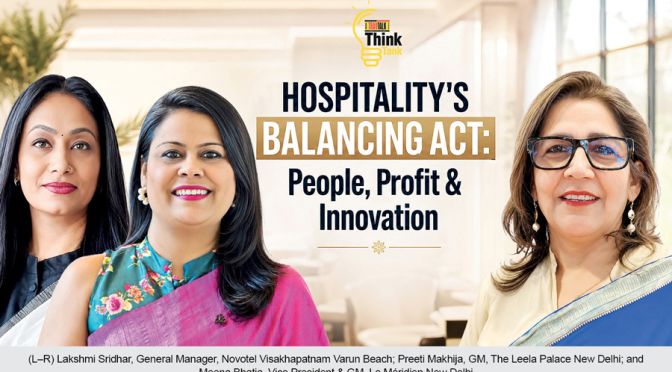
As hotels navigate a new-age workforce, changing guest expectations, sharper revenue pressures, and the rapid arrival of AI, women leaders in hospitality discuss what it will take to keep the business relevant.
Nisha Verma
There has been a dramatic change in hospitality over the past decade. We have seen technology altering how guests interact with hotels, expectations have become more immediate, luxury has moved away from simply being about opulence, and hotel leaders are under increasing pressure to balance guest satisfaction with commercial performance. Despite all the change, the fundamentals of hospitality remain constant. That was the central concern explored at the 9th edition of the TravTalk ThinkTank, organised on the theme ‘Hospitality’s balancing act: People, profit, and innovation’. Women leaders in the Indian hospitality industry shared their perspectives from their different journeys. The discussion covered a wide range of industry-related topics, including technology, sustainability, and operations.
What to hold on to?
For Meena Bhatia, Vice President & General Manager, Le Méridien New Delhi, who has spent four decades in the industry, technology and changing expectations have transformed how hospitality is delivered. “Things have evolved very fast, especially in the last decade. And technology has made a lot of difference,” she said.
Guests today want things delivered “seamlessly, quickly” and increasingly through technology. Yet, she believes, “Hospitality still means a warm welcome by a human being, and that is something that should never change in hospitality.”
For Preeti Makhija, General Manager, The Leela Palace New Delhi, the biggest shift is visible in the luxury traveller. Today’s guest is more informed, well-travelled, discerning, and no longer defines luxury simply through the grandeur of the property. “It is more about the experiences, the level of hyper-personalisation done for them, and authentic experiences planned for them,” she said. The guest, she added, is looking for genuine warmth rather than a transactional interaction. For The Leela, the challenge is to retain the brand’s graciousness and warmth while constantly evolving how that hospitality is expressed. “The whole perception of the experience that they would carry with them” is becoming more important than the grandeur of the hotel itself, Makhija said.
Talent wants a career, not just a job
People remain hospitality’s most difficult internal equation. The industry has long discussed a talent shortage, but the speakers pointed to both a genuine shortage and a changing workplace culture. “There is a talent shortage, and that is because there are multiple opportunities that have come up now,” Bhatia said.
Young professionals have more choices and are more willing to experiment with careers. At the same time, hotel operations have limitations that other industries do not. “Working in shifts and being there when needed is something the industry can’t avoid. Work from home is not an option for a career in hospitality,” she said. Hotels, she added, are responding with five-day working weeks, higher salaries, and other steps to remain attractive. But career progression may be the bigger issue, she explained. “The other big thing is growth, which many youngsters question —‘Where will I be?’”she added. Her answer is to make the hotel itself a learning ground. “I think our campus is in our own hotel, and if we grow our own people to higher positions and show them the way, they will stay in the industry,” she further added.
For Lakshmi Sridhar, General Manager, Novotel Visakhapatnam Varun Beach, who began her career journey as a telephone operator, understanding individual potential is critical. “It is very important for all of us to read the mind of our talent, know them better, and interact with them regularly,” she said.
Employees need more than a job. They need to see where they can go. “You need to understand the talent potential first, their pros, likes, dislikes, and everything to show them a career path. As mentors, we need to show them the line to grow, give them exposure to different departments, so that they can learn and grow along with the company,” she added.
At Novotel Visakhapatnam Varun Beach, she said, training-needs analysis is conducted quarterly, potential talent is identified early and mentorship programmes are used to prepare future leaders. Also, she claimed, “We need to be an active listener to these people. At times people leave the industry not just because of the industry. They leave because they feel that they are not heard or valued.”
Makhija echoed the importance of recognition and internal mobility, particularly in luxury hospitality, where guest expectations are exceptionally high. Her approach includes incentives linked to upselling and performance, along with frequent interaction between senior leaders and employees. “We have started getting into a one-on-one conversation rather than just talking to managers,” she said.
At The Leela Palace New Delhi, employees can approach the GM directly, while Makhija also spends time on the shop floor. “The suggestions are taken from them only. And most of the times we’ll act upon those suggestions and they feel that they are being valued, respected, and heard,” she explained. Training is another focus, including the Leela Centre of Excellence developed in partnership with GD Goenka University.
Rates must rise with demand
The discussion questioned if the focus should only be on occupancy, ADR, and RevPAR when the demand is high. “If there is demand, we must optimise our shares, be it from the occupancy, or from average rates,” Bhatia said.
She argued that dynamic pricing is a normal function of supply and demand, with hotels also discounting when demand weakens. The challenge, she said, is that Indian consumers often accept premium pricing overseas more readily than at home.
Makhija agreed that the mindset is changing. International travel is exposing Indian travellers to the cost of premium hospitality, while staycations, dining experiences, and major conventions are strengthening acceptance of higher domestic rates.
Guest experience & profit can coexist
Sridhar rejected the idea that guest experience and profitability are competing priorities. “They can go hand in hand. If we take care of the guest and if the guest feels valued, I think the business will automatically fall into place.”
She argued that discounting is not the only way to win business. Guests can choose a hotel even when a competitor is cheaper if the experience and personal touch justify the difference. “Every time it is not only the discount which matters to the guest, but also the kind of guest experience we deliver.”
For Makhija, hotel performance goes beyond revenue metrics. She looks at guest satisfaction, repeat guests, personalisation, employee engagement and retention, training, internal talent development, and F&B performance. “The culmination of all this put together will really define the priorities for a luxury hotel,” she said.
GM’s real office is the lobby
One of the strongest points of agreement was that a GM’s most valuable source of information may not be a dashboard, but the lobby. Makhija spends an hour in the breakfast room every morning. “Your guests should always be the number one priority because you are there because of them,” she said.
Bhatia agreed, saying, “What you learn in the lobby, nobody else can teach you. One round with the client, and so many things come to my mind, as to what needs to be done. What is a better strategy to run a hotel than this?”
Sridhar said, “If we manage guest and our team, everything will fall into place automatically.”
AI won’t change hospitality’s essence
There was little disagreement that AI is here to stay. The debate was about where it should be used. For Bhatia, AI is the latest stage in a long series of technological transformations. “Technology is for betterment, it must be used. There is no other way. AI is here to stay and is the next transformation,” she claimed. But technology should remain a tool, not become the definition of hospitality. “We have to always keep ourselves relevant to change with the times as it goes, but the one thing that should not change is the essence of hospitality,” added Bhatia.
Makhija sees AI’s strongest opportunity in using data to anticipate guest preferences and create intelligent personalisation. It can also reduce administrative work in HR, support engineering and improve operational efficiency. But she does not see technology replacing people in guest-facing areas. Sridhar put the distinction most succinctly, saying, “I feel the future is high tech. I have no doubt about it, but high touch is the core.”
Different leadership, same expectation
The presence of three women leaders brought leadership into the conversation, although the participants resisted reducing it to a conventional gender discussion. Bhatia questioned the assumption that women are necessarily more empathetic leaders. “I think we are more balanced, and our approach is very different.” Bhatia added that leadership differences are not necessarily explained by gender. Sridhar and Makhija agreed with the sentiment.
The balancing act
When asked to choose between people, profit, and innovation as the single priority for a hotel’s success over the next five years, all three GMs chose the same answer: people. The choice reflected the wider discussion. Technology can make service faster, revenue management can optimise rates, data can personalise experiences and sustainability can improve operations. But none of these works without people who understand hospitality.
Makhija also pointed to an issue beyond the hotel itself: destination marketing. “As hotels, we have been doing a lot, but as a nation, we could do better by promoting India,” she said.