
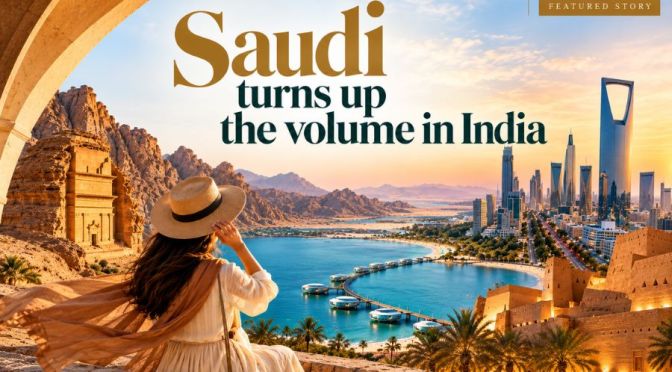
With air capacity from India rising, easier visa access, a rapidly expanding luxury portfolio and a fresh campaign in the works, Saudi is preparing for its next phase in the Indian market. This time, the conversation is moving beyond awareness towards experiences, conversion and longer-term partnerships with the travel trade.
For a destination that has spent the past few years introducing itself to the Indian traveller, Saudi appears ready for the next chapter. The question is no longer simply whether Indians know Saudi as a leisure destination. It is how quickly that awareness can translate into bookings.
India remains firmly among Saudi’s priority source markets, and despite a challenging geopolitical environment across the wider region, its tourism push here is being positioned for the long term. The immediate strategy brings together stronger air access, simpler visas, new tourism products and deeper partnerships with travel companies rather than relying on short bursts of promotion.
Perhaps the clearest indication is connectivity. Weekly air capacity between India and Saudi has reportedly risen by around 13.3 per cent year on year, from approximately 320 flights to 360 flights. New services and frequency additions are also widening the opportunity beyond the traditional Delhi and Mumbai gateways, giving markets in southern and western India greater importance.
That fits neatly into Saudi’s larger India strategy. Instead of treating the country as one homogenous market, the destination is increasingly looking at individual segments and source cities, matching products to the travellers most likely to buy them.
From campaigns to conversion
A new phase of Saudi’s campaign for India is also being prepared, building on the destination’s earlier localised marketing. The next iteration is expected to broaden the story with more destinations, particularly the Red Sea, while putting experiences at the centre.
It reflects a fairly simple understanding of the Indian holidaymaker. A beautiful hotel may attract attention, but it rarely makes an itinerary by itself. Indian travellers want things to see, do, photograph, eat and talk about when they return.
Saudi now has considerably more of that story to tell.
The Red Sea is emerging as one of its strongest luxury propositions, backed by an expanding collection of international hotels and resorts. Around 11 hotels are now part of the destination’s portfolio, with brands including SLS, EDITION, InterContinental, Four Seasons, St. Regis and Ritz-Carlton Reserve among the names entering the wider tourism landscape.
Then there is AMAALA, which is expected to give Saudi a much stronger proposition in wellness and ultra-luxury travel. A portfolio of international hospitality brands is taking shape there, creating another product that can eventually be marketed selectively to affluent Indian travellers rather than pushed as a mass-market holiday.
Interestingly, the opportunity may also lie in making Saudi easier to package for groups. All-inclusive resorts are entering the market, an important development for Indian GIT business where predictability of costs and ease of operation can make a destination significantly more attractive to tour operators.
Visa friction gets lighter
Access is another piece of the puzzle.
Saudi has been progressively simplifying its tourism visa journey, with newer digital options designed to make the process increasingly accessible through a traveller’s phone. These sit alongside existing eVisa and visa-on-arrival provisions for eligible travellers, including certain holders of valid US, UK, and Schengen visas.
Saudi’s Package Visa, launched as a pilot in July, gives Indian passport holders a digital route to a tourist visa when they book return flights and a licensed four-star-or-higher hotel through an approved provider. The scheme targets packaged leisure travel, combining trip planning and visa processing in one transaction.
For a relatively new leisure destination, that matters. Removing one more perceived complication can make the difference when Saudi is competing against destinations Indians already understand and know how to book.
But Saudi’s India plans are increasingly about what happens behind the scenes too.
Engagement with travel companies is shifting from campaign-by-campaign partnerships towards multi-year plans. The objective is to get large travel businesses to consider what Saudi could contribute to their portfolios over the next four or five years and then invest accordingly in product development, technology, training and distribution.
It is a notable change in approach. Saudi does not merely want shelf space. It wants the Indian trade to build a business around the destination.
Groups and MICE move up the agenda
Two segments are becoming particularly important, GIT and MICE.
Saudi has already hosted groups and incentives from India, but both are being identified as areas with considerably more potential. Developing easier group products, improving on-ground arrangements and working closely with Indian operators could help take Saudi beyond its current affluent FIT base.
The destination also has a natural advantage for MICE. Investment, business links and large-scale developments are already generating corporate movement, while Riyadh and other Saudi cities continue to build the infrastructure and events ecosystem required for larger groups.
At the same time, Saudi is attempting to establish itself as a place where the global tourism industry meets. The next edition of TOURISE is scheduled for March and is expected to bring together tourism leaders, policymakers, technology companies, airlines, financial institutions and other sectors around international collaboration and the future of travel.
Women are changing the Saudi story
There is another, quieter change worth watching.
Women are increasingly becoming part of Saudi’s tourism narrative, not simply as family travellers but as solo visitors, entrepreneurs and participants in special-interest groups. Women-only retreats, wellness-led travel and even a women bikers’ journey through the country point towards a different and increasingly diverse visitor profile.
Global visitor data indicates women accounted for around 45 per cent of travellers in 2024, rising to approximately half in 2025.
For India, this could be particularly interesting. Women already represent an important part of the country’s corporate and entrepreneurial travel base. As more visit Saudi for work, events and business, there is an opportunity for those journeys to become leisure extensions and, eventually, recommendations to friends and family.
Saudi beyond the five-star stay
Perhaps the biggest challenge now is not creating more tourism product. It is making travellers understand just how much already exists.
Saudi’s proposition is becoming surprisingly broad. There is Riyadh’s increasingly cosmopolitan city experience, Jeddah and its heritage, AlUla’s landscapes and history, the resorts of the Red Sea, emerging wellness destinations, cuisine, shopping, adventure and a rapidly evolving events calendar.
Even shopping and food, two natural hooks for Indian travellers, have arguably received less attention than they deserve.
That may now change.
After months of relatively restrained activity, Saudi is preparing to become more visible again in India. The timing could prove important. Indians are experienced, restless travellers with an enormous choice of destinations, and staying on the bucket list increasingly requires staying in the conversation.
Saudi has spent the first part of its tourism journey telling India that it is open.
Its next job is considerably more interesting. It has to give Indians enough reasons to actually go.

Rahul Bhadana is a digital editor at TravTalk with experience spanning multiple content niches, with a strong focus on travel trade journalism and digital publishing. A graduate of Delhi University, his work covers editorial writing, content strategy and platform-led storytelling, supporting TravTalk’s digital growth and industry engagement. A technology enthusiast, he enjoys films, poetry and exploring new ideas across media and culture.