
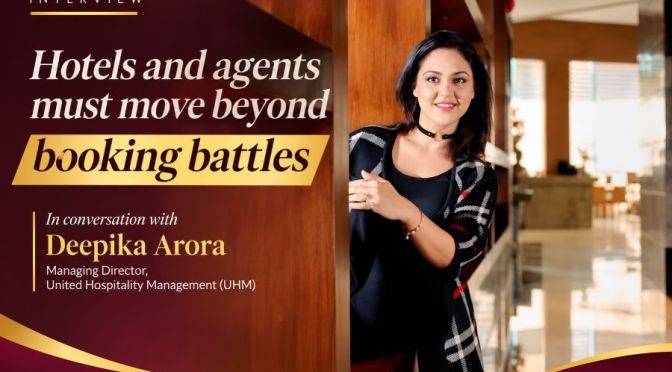
As hotels push direct bookings, Deepika Arora, Managing Director, United Hospitality Management (UHM) India and Head India, Dusit International, calls for stronger trade partnerships built on shared guest data, fair commissions, and mutual profitability.
Hotels may be investing more in direct booking channels, but travel agents and tour operators continue to play an important role in reaching customers and influencing their travel decisions. For Deepika Arora, the answer is not to choose one channel over another, but to make both work towards a common commercial goal.
“I think direct bookings and travel trade partnerships are not competing channels but complementary ones. The objective for any hotel should be to maximise revenue, improve profitability and build long-term guest relationships,” she says.
Direct bookings give hotels greater control over guest engagement, loyalty, and distribution costs. However, travel agents bring destination expertise, personal relationships, and access to customer segments that hotels may struggle to reach independently. In a market as diverse as India, both channels have a role to play.
Arora believes hotels must decide their distribution mix based on their positioning, location, target audience, and cost of acquiring business. The focus, she says, should be on securing the right business at the right cost rather than prioritising one booking channel over another.
Technology cannot replace relationships
While hotels can use technology to make bookings easier, Arora believes travel agents offer something that direct platforms cannot fully replicate: trust and personal advice.
“Beyond selling rooms, travel agents curate experiences, understand traveller preferences and connect hotels with customer segments they may not otherwise reach,” she says.
This becomes particularly important for boutique and experiential properties, where selling a room is only part of the conversation. Agents help communicate what makes a destination or property worth visiting and match that experience with the traveller’s expectations.
“Technology simplifies bookings, but relationships influence decisions,” Arora adds.
For hotels, this means direct booking investments should not come at the expense of trade engagement. Instead, both channels should complement each other, bringing different customers into the business.
Who owns the guest data?
The relationship becomes more complicated when hotels and agents both want to build long-term connections with the same customer. Arora believes the industry needs to move away from the idea of customer ownership.
“Firstly, the starting point is to recognise that the guest belongs to neither the hotel nor the travel agent. The relationship is built on trust, experience and the value each brings,” she says.
She advocates sharing relevant guest preferences, travel patterns, and feedback, provided customers give their consent and appropriate data privacy safeguards are in place.
Travel agents influence the booking decision, while hotels deliver the stay. Sharing information responsibly can help both understand guest expectations, personalise experiences, and encourage repeat business without competing for the same customer.
Commissions need a rethink
Arora also believes hotel–trade partnerships must evolve beyond commissions and individual bookings. Commission structures, she says, should reward the quality of business, incremental demand, and the ability of agents to support hotels during softer periods — not just booking volumes.
She also wants loyalty programmes and repeat-booking models to recognise the role agents play in introducing guests and building lasting relationships, while respecting individual hotel brand policies.
“Hotels need profitable business, while travel partners need fair recognition and confidence in the product they recommend,” she says.
Building partnerships beyond transactions
Arora’s perspective draws on experience across international hotel companies and independent hospitality businesses, as well as building her own hospitality brand, Rosastays. She believes successful hotel–trade relationships depend on transparency, fair commercial terms, and clearly defined roles.
For the travel trade, the message is clear: the future of hotel distribution should not be a contest over who secures the booking or owns the customer. Hotels need agents to reach the right travellers, while agents need hotels to deliver the experience they promise. Bringing these strengths together can create more repeat business, stronger guest relationships, and better commercial returns for both sides.

Rahul Bhadana is a digital editor at TravTalk with experience spanning multiple content niches, with a strong focus on travel trade journalism and digital publishing. A graduate of Delhi University, his work covers editorial writing, content strategy and platform-led storytelling, supporting TravTalk’s digital growth and industry engagement. A technology enthusiast, he enjoys films, poetry and exploring new ideas across media and culture.