
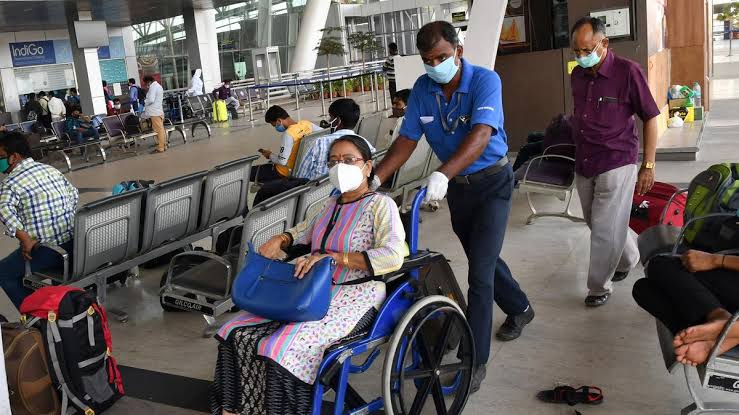
The Directorate General of Civil Aviation (DGCA) has proposed new rules to prevent the misuse of wheelchair services by able-bodied passengers. As per the draft Civil Aviation Requirements (CAR), airlines may charge an assistance fee for passengers who are not persons with disabilities or reduced mobility but still request such services. Free assistance will continue for travellers with documented physical or mental impairments. These changes are open for public feedback until September 19 and come ahead of a Bombay High Court hearing on wheelchair availability and accessibility for special-needs travellers.
The DGCA’s draft mandates that airports must have designated, unobstructed car drop-off points for passengers with special needs. These areas should display clear signage and be staffed to coordinate directly with airlines. Reserved seating areas inside terminals must comply with the Accessibility Standards and Guidelines issued by the Ministry of Civil Aviation. Additionally, airports are encouraged to offer digital maps accessible via QR codes to assist navigation.
The rules define a person with disability as someone with a physical or mental impairment, either temporary or permanent, supported by medical documentation. Persons with reduced mobility are those whose movement is limited due to disability, age, or other conditions. The DGCA emphasises that providing wheelchair access is a joint responsibility of airlines and airports. International carriers like Singapore Airlines and Emirates already offer “meet and assist” services, which could serve as a model for India.
Advocates, however, have raised concerns about the draft. Vaishnavi Jayakumar of the Disability Rights Alliance argues that the proposal risks being discriminatory by placing wheelchair assistance fees in a disability-specific regulation instead of a general passenger service policy. She points out that not all disabilities are visible and that passengers with invisible disabilities may also require wheelchairs or similar support.
The draft also highlights the need for better infrastructure, such as curbside assistance, ambulifts, golf carts, and buggies for senior citizens or those unable to walk long distances in large airports. Current shortcomings have led to unsafe situations, such as wheelchair users being manually carried down stairs. Some major airports in India, like Delhi and Mumbai, offer paid meet-and-greet services, but these are not yet standard across the country.
The Bombay High Court’s involvement stems from petitions highlighting inadequate wheelchair services. In one case, an elderly woman had to give up her booked wheelchair for her daughter with acute arthritis, while in another, a passenger fell from an escalator after her booked wheelchair was not provided. The DGCA has previously fined airlines for such lapses, including a INR 30 lakh penalty after the death of an 80-year-old passenger at Mumbai airport. The draft rules aim to ensure that such incidents are not repeated.