

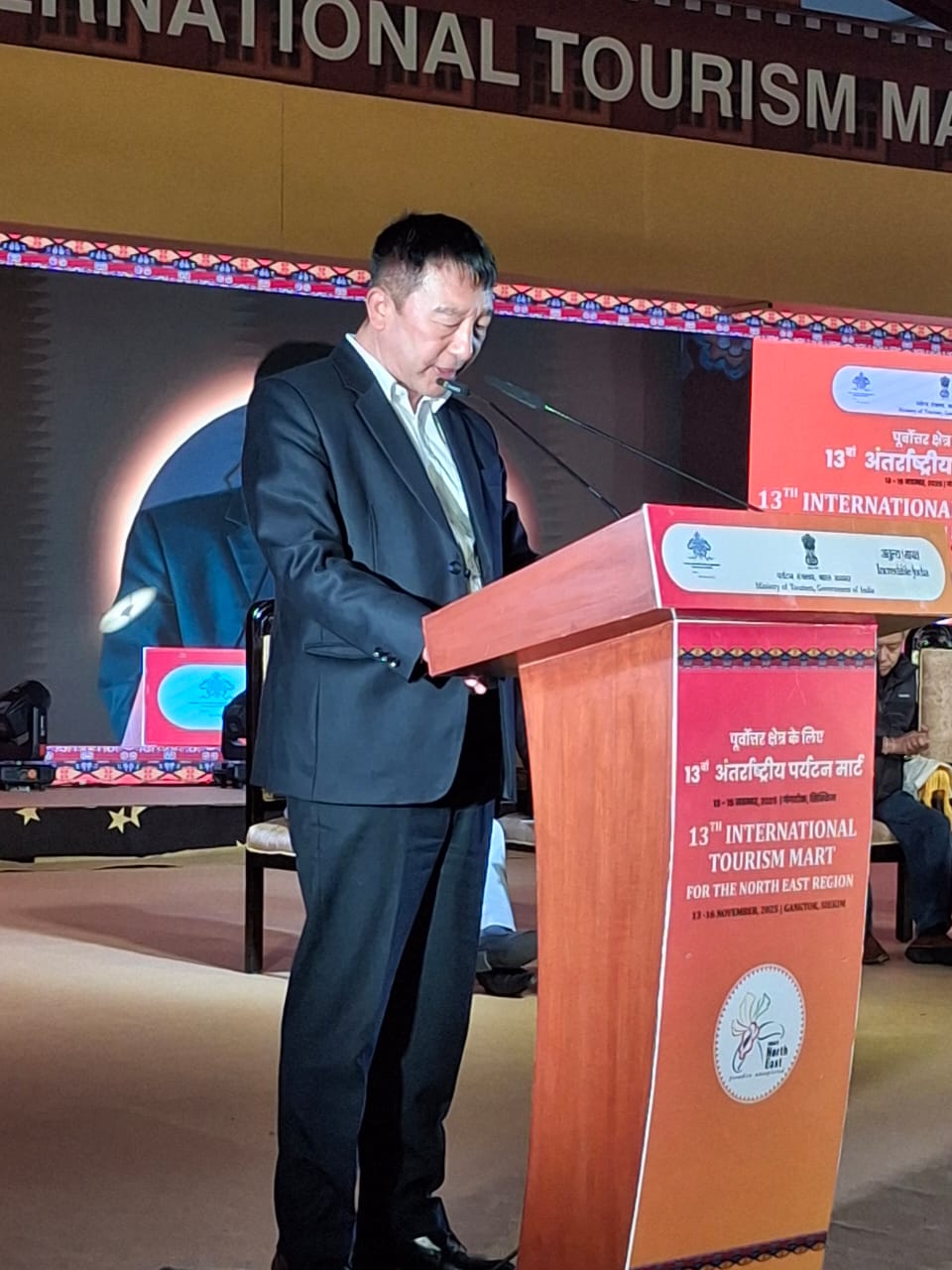
At the inaugural of the 13th International Tourism Mart (ITM) for the North East Region in Gangtok, Sikkim Tourism Minister Tshering Thendup Bhutia highlighted the state’s rich tourism offerings while making a strong appeal to the Central government to resolve its pressing connectivity challenges.
Sikkim Tourism Minister Tshering Thendup Bhutia has made an urgent call for Central government support to upgrade the vulnerable NH-10 and develop an alternative highway to ensure reliable, year-round connectivity to the Himalayan state. Speaking at the inaugural ceremony of the 13th International Tourism Mart (ITM) – the Ministry of Tourism’s flagship B2B platform to promote products of the eight northeastern states – Bhutia said that Sikkim’s ability to realise its full tourism and economic potential is severely constrained by frequent disruptions along the state’s lone arterial road.
“National Highway 10 serves as the primary arterial link between Sikkim and the rest of the country. However, its narrow width, vulnerability to landslide and frequent weather-related disruptions pose serious challenges to the state’s connectivity. Every time NH-10 is blocked, Sikkim breaks – being completely cut off, impacting tourists, local businesses, essential supplies and emergency services,” he said.
Calling for a long-term structural solution, the minister stressed that upgrading NH-10 into an all-weather highway is essential for the state’s economic security. Bhutia also underlined the need for an alternate highway to protect the state from recurring disruptions. “The need of an alternative highway built through geographically safer terrain is no longer optional but essential. Once robust and reliable highway infrastructure is in place, there will be no stopping Sikkim tourism,” he asserted.
Representing the host state at ITM 2025, the minister showcased Sikkim’s natural beauty, biodiversity, spiritual heritage and its position as a model of sustainable and responsible tourism. Describing Sikkim as “a jewel of the Himalayas”, he highlighted the state’s majestic landscapes, organic agriculture, vibrant ethnic traditions and peaceful society.
“It is indeed a great joy to share that Sikkim, covering just 0.2% of the country’s geographical area, has about 26% of the total floral biodiversity of the world,” he said, noting the state’s diverse flora and fauna— including snow leopards, red pandas, Himalayan black bears, and over 550 species of birds.
While the state wanted to broaden its tourism to new and emerging segments of MICE, adventure, wedding tourism, etc., the tourism minister said that the approach of the state would be to conduct these in a “conscious and controlled manner,” keeping in consideration the environmental and social impacts on the small state’s natural environment and people’s life.
Bhutia highlighted major infrastructure developments completed in recent years under various Central schemes such as Swadesh Darshan 2.0, PRASHAD, NEC and PM-DevINE. These include two ropeway facilities at Bhaleydhunga and Pelling; the state-of-the-art skywalk at Pelling, the border experience facilities at Nathula, and the Gangtok Cultural Village, among others.
He also spoke about the mega homestay scheme under which over 1,000 homestays have been allotted to genuine beneficiaries across the state, aimed at strengthening rural tourism and community income.
To attract high-value travellers, Sikkim has launched a 26-seater helicopter service between Bagdogra and Gangtok from the Burtuk heliport. The upcoming Sivok–Rangpo railway line, he said, would significantly enhance accessibility once completed.
Bhutia reiterated that the northeastern region, with its pristine landscapes, cultural richness and diverse tourism opportunities, is on the path to becoming a global tourism hub. He said that platforms like ITM showcases the shared aspiration of the region to emerge as a preferred tourism destination for tourism for the world.
As Sikkim seeks to expand its tourism footprint, the minister made clear that connectivity remains the most critical enabler. With reliable highway infrastructure, he said, Sikkim can emerge as a top global destination for nature, adventure, wellness, heritage and sustainable tourism.