

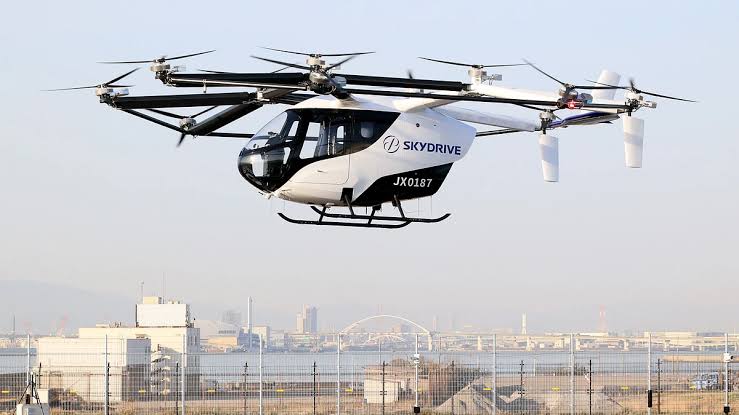
A new report by the Confederation of Indian Industry (CII) has proposed setting up a pilot air corridor connecting Gurugram, Connaught Place, and Jewar International Airport to drastically cut travel time in the Delhi-NCR region. The study suggests that such an air corridor could reduce journeys that currently take hours by road to just a few minutes, offering a powerful solution to chronic urban traffic congestion.
Titled “Navigating the Future of Advanced Air Mobility in India,” the report was launched by Union Civil Aviation Minister Rammohan Naidu Kinjarapu. He said India’s aviation sector is transitioning toward a high-tech, multi-dimensional mobility ecosystem, with advanced air mobility playing a key role in shaping the future of urban transportation.
One of the report’s major highlights is the use of electric vertical take-off and landing aircraft, or eVTOLs, commonly referred to as air taxis. The study proposes using rooftops of existing buildings as landing, parking, and charging points. This approach could significantly reduce costs, as acquiring land for ground-based landing pads in major cities is both expensive and time-consuming.
By converting rooftops into operational hubs, buildings could also generate new revenue streams. The report notes that cities such as Delhi, Mumbai, and Bengaluru are well suited for this model due to their dense urban infrastructure and growing demand for faster connectivity. Rooftop-based operations would allow quicker rollout of services compared to traditional airport-linked infrastructure.
However, the report acknowledges that current aviation regulations do not permit routine commercial flights from rooftops. To address this gap, it recommends setting up a dedicated vertical within the Directorate General of Civil Aviation (DGCA) to develop safety, certification, and operational standards specifically for advanced air mobility and eVTOL operations.
CII Task Force Chairman on Advanced Air Mobility, Amit Dutta, said the study moves the concept from vision to execution. By analysing a hypothetical Delhi-NCR corridor through structured modelling and regulatory scenario testing, the report addresses key challenges related to airspace, infrastructure, and regulation. It also suggests starting with drones for cargo and medical logistics over 50–100 km before scaling up to passenger air taxis, paving the way for a cleaner and more connected urban India.