

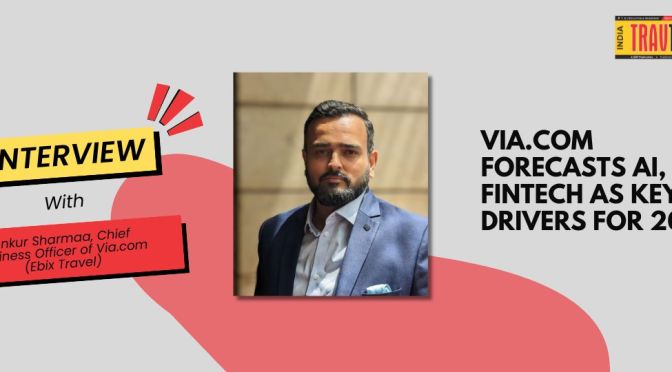
In a discussion on the evolving travel landscape, Ankur Sharma, Chief Business Officer of Via.com (Ebix Travel), outlines the critical role of technology. He explains how agents can leverage AI as a co-pilot, shares his tech forecast for 2026, and details the shifts the industry must brace for in the coming year.
As travel distribution becomes increasingly data-driven, technology is reshaping how agents sell, service and scale their businesses. Artificial intelligence, fintech integration and predictive intelligence are no longer optional tools but competitive necessities. In this interview, Ankur Sharma, Chief Business Officer, Via.com (Ebix Travel), outlines how agents can work alongside AI, the technology shifts expected in 2026, and the changes the industry must prepare for in the year ahead.
Is there a way for agents to work with AI to up their revenue/efficiencies?
Yes, AI must be viewed as a powerful new co-pilot to help and empower travel agents, not replace them. The primary revenue opportunity lies in ancillary services and personalised upselling. AI should be integrated to analyse the customer’s demographic data, understanding their trending behaviours and budget levels. This allows the agent to shift focus from merely booking the main ticket to offering budget-optimised ancillary products (e.g., insurance, premium seating, activities) with perfect timing. By automating data analysis and inventory alignment, AI frees agents to focus on the high-touch, consultative sales that increase both efficiency and revenue per customer.
What according to you is the tech forecast for 2026?
The tech forecast for 2026 centres on ‘Invisible Intelligence’ and FinTech integration. We anticipate three key shifts: First, Generative AI will transition from basic itinerary creation to deeply personalised customer service bots that handle complex queries and rebookings autonomously, driving cost savings. Second, platforms will pivot from basic price comparison to predictive budget allocation, suggesting budget-optimum travel and ancillary packages upfront. Third, the line between travel and finance will vanish, with integrated payment and travel intelligence platforms offering instant cross-border payments, BNPL, and fraud prevention as standard features, all working quietly in the background.
What does the industry need to know and brace for in the new year?
The industry needs to brace for the accelerating demand for integrated digital ecosystems and a complete overhaul of the traditional agent-customer relationship. The key is to leverage the technological advantage that FinTech provides. The industry must move quickly to ensure every digital service (booking, payment, visa) is perfectly aligned, transparent, and instantly available. Agents must embrace AI to become hyper-local knowledge experts, using data tools to gather knowledge on destinations and quickly lean into trending products. The era of static inventory and manual processes is over; scalability, personalised service, and FinTech-backed reliability will define winners in the new year.

Rahul Bhadana is a digital editor at TravTalk with experience spanning multiple content niches, with a strong focus on travel trade journalism and digital publishing. A graduate of Delhi University, his work covers editorial writing, content strategy and platform-led storytelling, supporting TravTalk’s digital growth and industry engagement. A technology enthusiast, he enjoys films, poetry and exploring new ideas across media and culture.