

A series of geopolitical flashpoints and aviation disruptions has unsettled India’s outbound travel market, forcing travellers and tour operators to rethink plans. With bookings down 15–20% and cancellations rising up to 30%, the sector is looking at losses to the tune of Rs. 8,000–10,000 crore.
Janice Alyosius
Geopolitical shocks and operational disruptions have converged to make FY2025–26 one of the most turbulent for India’s outbound travel sector. The Pahalgam terror attack, escalating Middle East tensions, Nepal/China airspace volatility, the Air India Flight AI171 crash, and IndiGo’s fleet grounding issues have collectively disrupted traveller confidence and planning cycles.
Industry estimates suggest aggregate losses for Indian outbound operators are in the range of `8,000–10,000 crore, driven by refunds, rescheduled itineraries, and funds locked in airline credits. Financial strain is evident across the value chain, with `3,500 crore in refunds and `4,000–5,000 crore tied up in credits, creating liquidity pressure, particularly for smaller players.
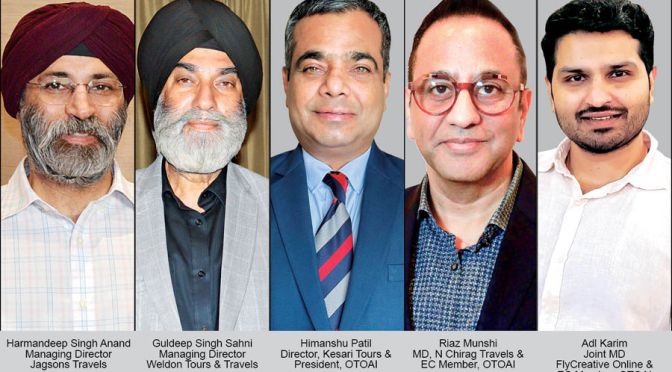
Harmandeep Singh Anand, MD, Jagsons Travels, quantifies the scale of disruption. “Geopolitical events led to a 15–20 per cent year-on-year decline in outbound bookings for us from Q3 FY25 onward. West Asia markets such as Dubai and Israel saw a 40 per cent drop post the October escalations, while Europe dipped around 12 per cent,” he says. He adds that cancellations have risen sharply. “Cancellations spiked to 25–30 per cent, compared to our usual 8 per cent. Nearly 60 per cent of these were linked to Middle East advisories and the Air India incident.” Guldeep Singh Sahni, MD, Weldon Tours & Travels, highlights the operational strain. “There were enough inquiries, but passengers remained confused and kept asking for options,” he says.
“Margins were already under pressure, and cancellations kept coming in. While airlines were supportive and hotels allowed postponements, the bigger issue was that money got stuck for long periods. Clients were constantly following up for refunds. Rescheduling meant additional time and effort with no additional revenue, so profitability took a direct hit,” he adds.
Niraj Vashi, Founder & CEO, Nivalink, points to a broader shift in travel sentiment. “Travel is highly sensitive to perception. Any shift in macroeconomic conditions, political uncertainty, or even weather patterns leads travellers to delay or reassess plans. What we are seeing now is more postponements than outright cancellations, but that still impacts overall volumes,” he explains. “The prolonged Israel-US conflict with Iran is likely to have a deeper and longer-lasting impact than recent disruptions,” he elaborates.” As uncertainty persists, short-haul and “safe” destinations are gaining traction.
Anand points out that Southeast Asia has emerged as a strong alternative. “Thailand is up 25 per cent, Vietnam 18 per cent, and Bali 15 per cent. Domestic destinations such as Ladakh and the Andamans have also seen a 30 per cent increase,” he says. “At the same time, traditional strongholds have weakened — Dubai is down 35 per cent, the Maldives has dropped 20 per cent, and Europe has declined around 15 per cent due to rising costs,” he adds. Himanshu Patil, Director, Kesari Tours and President, OTOAI, says unpredictability is now the biggest challenge. “Travel demand is still there, but it is no longer predictable. Whenever there is uncertainty, people delay bookings, which makes planning more complex,” he says. Riaz Munshi, MD, N Chirag Travels and Executive Committee Member, OTOAI, notes that demand has shown resilience despite disruptions. “We observed a temporary dip in bookings, with cancellations increasing by around 10–15 per cent. However, demand did not disappear,” he says.
Adl Karim, Joint MD, FlyCreative Online and Executive Committee Member, OTOAI, said, “We had projected a growth of around 20–25 per cent, but instead we ended up doing numbers similar to the previous year,” he says. “The financial impact has been from both ends. Refunds are stuck on the supplier side, leading to delays in payments,” he said.