

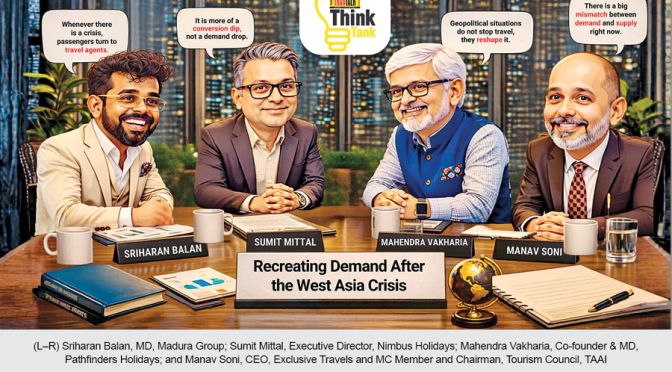
As geopolitical developments once again test the resilience of global travel, the latest TRAVTALK ThinkTank convened senior industry leaders from different parts of India to address a critical and timely theme — ‘Recreating Demand After the West Asia Crisis’.
Nisha Verma
The fifth edition of TRAVTALK ThinkTank was designed to go beyond immediate disruptions and decode the deeper shifts shaping the market. With participants representing diverse source markets, such as Ahmedabad, Kolkata, Chandigarh, and Chennai, the conversation captured a wide spectrum of on-ground realities, particularly from emerging tier II and III cities that are now central to India’s outbound growth story.
The core question driving the discussion was simple yet complex — is demand truly slowing down, or is it undergoing a structural shift? What emerged was a clear consensus — demand has not disappeared. It is evolving. The challenge for the industry lies not in waiting for recovery, but in actively recreating demand through smarter selling, stronger communication, and sharper positioning.
In transition, not decline
The immediate reaction to the West Asia crisis has been one of caution, but no one is in a mood to retreat. Across markets, it is that the trend is not one of cancellations, but of recalibration. Mahendra Vakharia, Co-Founder & Managing Director, Pathfinders Holidays, pointed out that a majority of travellers are continuing with their plans, albeit with adjustments. “About 80 per cent of clients who had planned to travel are still continuing with their plans, but a lot of them have turned to domestic travel, and Asian destinations have started doing very well again,” he said.
This shift reflects a growing willingness among travellers to adapt rather than abandon travel altogether. However, a segment of the market has chosen to pause. “There are a lot of them who have taken a pause. They are waiting for one or two months before deciding,” he added.
Going Eastward, Manav Soni, CEO, Exclusive Travels and MC Member and Chairman, Tourism Council, TAAI, highlighted the emotional undercurrent within the industry itself. “There is a sentiment of fear. The entire mood of the travel fraternity is low. The uncertainty of when things will restart is what is troubling people,” he shared.
This sentiment, while not directly impacting demand, is influencing how the trade approaches business in the short term. Meanwhile, Sumit Mittal, Executive Director, Nimbus Holidays, offered a perspective from the premium segment, where the dynamics are slightly different. “Budgets are not a big concern, but safety and feasibility is. The demand has dipped, but there has been more of a shift,” he claimed.
Traveller has evolved
What dominated the entire discussion was how traveller behaviour itself is evolving, and how this is reshaping the industry. Sriharan Balan, Managing Director, Madura Group, highlighted a clear shift in how travellers approach planning.
“Earlier clients would come with a destination. Now they come with an itinerary,” he claimed. This change reflects increased access to information and a more engaged decision-making process. “Passengers are more aware now. They know there are multiple options available,” he added.
However, awareness also brings complexity. Travellers are more demanding, more selective, and more influenced by external factors, including social trends. “Travel is no longer just about seeing a place. It has become a matter of prestige and social influ ence,” underlined Balan. This shift is redefining not just demand, but the way travel needs to be sold.
How to convert intent into bookings
One of the most important insights from the ThinkTank was the distinction between demand and conversion. While traveller interest remains intact, translating that interest into confirmed bookings has become more difficult. Articulating this, Mittal said, “I would say it is more of a conversion dip. For the first two to three weeks there was silence and only discussions happening.” This phase of hesitation reflects a broader behavioural shift where travellers are seeking reassurance before committing. The decision-making cycle has lengthened, and the need for clarity has increased. Vakharia further contextualised this in a larger framework, saying, “Geopolitical situations do not stop travel, they reshape it.”
He said the role of perception is influencing behaviour at this time. “Anxiety is the most important factor. Nobody wants to go into a situation where there could be disruption.” Overall, the challenge is not creating demand but generating confidence.
Price and connectivity beckon
Apart from the broader sentiment, there are structural challenges, particularly airfare volatility and limited connectivity, which are playing a significant role in shaping travel decisions. Soni pointed out, “There is a big mismatch between demand and supply right now… because of that, prices have surged.” This mismatch is not just a temporary disruption but could signal a longer-term shift. “Once airlines raise prices, they would like to keep that as a benchmark. The market has adapted to those fare levels,” he added.
Reinforcing this concern, particularly in the premium segment, Mittal informed, “Business class fares have almost doubled, and the inventory is not there.” The result is a market where travellers are willing but constrained by access and affordability. This has made pricing a critical factor, not necessarily in deterring travel, but in influencing destination choices and timing.
Timely packaging key
Beyond destinations and pricing, the discussion also highlighted the growing importance of how travel is packaged and timed. As uncertainty shapes decision-making, travellers are increasingly looking for flexibility — both in itineraries and financial commitments. Vakharia underscored the need to adapt offerings in line with traveller sentiment. “A lot of travellers have shifted their plans, but they still want to travel,” he added. This has made flexibility a key driver of conversion.
Mittal pointed out, “It is more of a conversion dip. Clients are discussing, but taking longer to decide.”
In such a scenario, reassurance and adaptability become critical. Soni added, “The uncertainty is what is troubling people.”
This is where curated, responsive planning plays a role. Balan noted, “Passengers are more aware now. They expect multiple options.” Together, these shifts underline a clear reality — flexibility is no longer an add-on, but central to recreating demand.
Industry response
To fight these challenges, the travel trade is not waiting for conditions to stabilise. Instead, it is actively redirecting demand towards alternative destinations. Vakharia highlighted how this shift is already underway. “Clients who were planning Europe have shifted to Australia, New Zealand, South Africa… and Japan is doing extremely well,” he said. He also pointed to a resurgence in domestic tourism, saying, “Chardham Yatra and Kailash Mansarovar are seeing very good response.” This pivot reflects both necessity and opportunity. Mittal described the current scenario as just of partial disruption instead of a complete shutdown. “It is only a partial disruption of one region. There are so many alternative destinations available,” he elaborated. He too underlined the emergence of new destinations choices by travellers. “Clients are now looking at places like the Philippines and parts of Indonesia and Malaysia,” he added.
This openness to exploration is creating new avenues for growth, particularly for agents willing to expand their offerings.
Return of the travel agent
In an increasingly uncertain environment, the role of the travel agent has regained prominence. Balan pointed out that crises tend to drive travellers back to trusted advisors. “Whenever there is a crisis, passengers turn to travel agents. Even those who have not contacted us in years are reaching out.”
This renewed reliance is rooted in the need for guidance, reassurance, and problem-solving — areas where human expertise holds an advantage over automated travel platforms.
Soni reinforced this perspective, underlining, “Personal connect is very important. No matter how much technology comes in, it gives an edge.” Offering a nuanced view of the role of OTAs, he said, “OTAs help filter out non-profitable business, but serious travellers come back to agents.”
This dynamic suggests a rebalancing of the ecosystem, where both channels coexist but serve different purposes.
Time to sell smarter
One clear takeaway from the discussion was that it is the need for the industry to evolve its approach to selling. Mittal emphasised the importance of taking initiative. “We need to take the lead, understand our clients, and give them options, rather than waiting for them to ask,” he said. This shift from reactive to proactive selling is critical in a market where uncertainty can delay decisions. He also highlighted the growing importance of domestic tourism, and shared, “I am more than happy selling a well-curated domestic itinerary. Margins depend on the effort and knowledge you bring in.”
Vakharia framed this shift as an opportunity for recalibration. “It is not the end of the road; it is just a bend. We need to rethink and offer alternatives,” he suggested. This mindset of adapting, rather than retreating, is emerging as a key differentiator.
Communications should be credible
In an environment where misinformation can spread rapidly, credible communication has become a critical tool for the travel trade. Vakharia highlighted the challenge of unverified information influencing traveller decisions. “We are constantly bombarded with unauthenticated messages. However, we rely on our ground partners and verified sources,” he shared. He emphasised that confidence in communication directly impacts conversion. “When we share verified information, clients trust us and move forward,” he claimed. This reinforces the role of agents not just as sellers, but as reliable sources of information.
Adaptability to define success
As the discussion concluded, the focus shifted from immediate challenges to long-term outlook. Balan offered a pragmatic assessment of the road ahead, and said, “This shift will make some agents stronger, and some may not survive, but adaptation is the key.”
He also emphasised the importance of maintaining a positive narrative. “If we guide clients well and communicate confidently, demand will come back,” he claimed.
Mittal summed up the industry’s current position with clarity. “We are not in survival mode. We are in a pivoting mode.” This shift in mindset — from crisis management to opportunity creation — captures the essence of the discussion.