

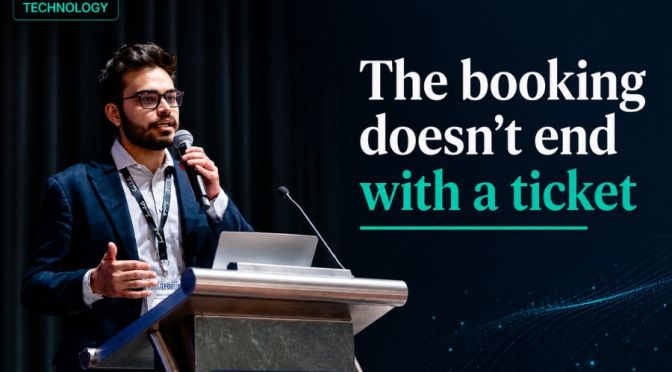
Accommodation booking is often the first point at which event organisers, ticketing platforms, and travel intermediaries lose visibility over their customers’ journey. As travellers move elsewhere to book hotels, the transaction, customer relationship, and commercial opportunity frequently move with them, opening the door to new approaches that keep the booking journey connected.
ProximIT is positioning its proximity-first hotel search platform as infrastructure that can be integrated into existing travel, event, and ticketing platforms. Rather than directing users to external booking sites, the model enables partners to offer accommodation around a specific venue, event, hospital, or attraction while retaining the customer within their own digital ecosystem.
 Aman Narula, CEO, ProximIT, believes the opportunity extends well beyond hotel booking itself.
“Event organisers, ticketing companies, and venue owners are sitting on extremely high-intent traffic that they currently send away the moment someone needs a hotel,” said Narula.
When a traveller purchases an event ticket, the accommodation search often begins immediately afterwards, but typically on a search engine or an online travel agency. That transition disconnects the booking journey from the original platform.
“A user buys a ticket, searches for accommodation, and leaves the platform entirely to book on Google or an OTA, taking the booking, the data, and the relationship with them,” he added.
Keeping the booking journey connected
Integrating accommodation into the same booking flow enables organisers and travel platforms to extend the customer journey beyond a single transaction.
“They can earn a margin on every hotel booking generated, increase time spent on the platform, and turn a single ticket purchase into a complete trip, accommodation included,” Narula said.
He believes convention centres and venue owners can also strengthen relationships with organisers by making nearby accommodation part of the overall event proposition rather than an external service.

A tool for travel advisors
The same approach can support travel advisors managing corporate, group, and event-related travel, where proximity often influences accommodation recommendations more than destination alone.
“Travel agents and tour operators have always added value through expertise, knowing the right hotel for the right trip,” said Narula.
Instead of manually comparing neighbourhoods or researching distances, advisors can identify hotels ranked by their proximity to the venue before recommending suitable options.
“For tour operators handling group MICE bookings, this becomes even more valuable. They can quickly identify clusters of hotels near a convention centre to negotiate group rates or recommend options that keep an entire delegation close together,” he added.
Beyond business events
While corporate travel and MICE represent the company’s immediate focus, Narula sees the same proximity-driven model applying across several travel segments where location is tied to a specific purpose.
“Religious and medical tourism are two of the clearest opportunities, particularly relevant to a market like India,” he said.
Pilgrims travelling to a temple or shrine, patients seeking treatment at a particular hospital, visitors attending university graduations, cruise passengers departing from a port, and spectators travelling for concerts or sporting events all begin their journeys with a specific location rather than a destination.
“Across all of these, the common thread is the same: the traveller already knows exactly where they need to be, and the booking experience just hasn’t caught up to that yet,” added Narula.
Building through partnerships
Looking ahead, ProximIT plans to expand through integration partnerships rather than developing a consumer-facing booking platform.
“My vision for ProximIT in Asia Pacific, and India specifically, is to become the proximity layer underneath the platforms already serving this region’s fast-growing MICE, religious tourism, and corporate travel sectors,” said Narula.
Success over the next 24 months, he noted, will depend on building partnerships across multiple travel segments, expanding hotel coverage across Indian markets, and demonstrating sustained booking volumes through those integrations.

Rahul Bhadana is a digital editor at TravTalk with experience spanning multiple content niches, with a strong focus on travel trade journalism and digital publishing. A graduate of Delhi University, his work covers editorial writing, content strategy and platform-led storytelling, supporting TravTalk’s digital growth and industry engagement. A technology enthusiast, he enjoys films, poetry and exploring new ideas across media and culture.