

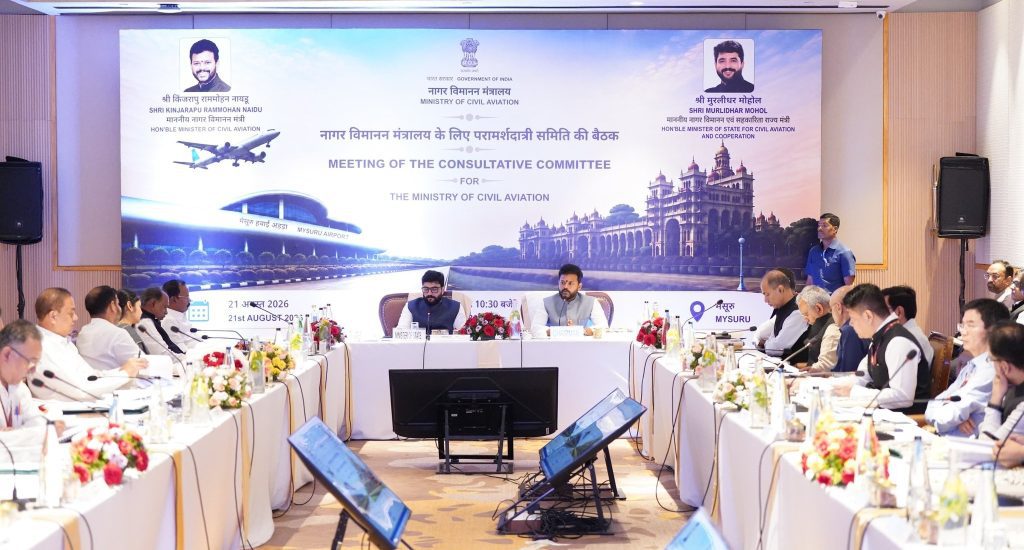
Civil Aviation Minister Kinjarapu Ram Mohan Naidu chaired a meeting of the Parliamentary Consultative Committee of the Ministry of Civil Aviation in Mysuru, Karnataka on Friday, with discussions centred on the next phase of the UDAN scheme, reforms in the Flying Training Organisation (FTO) ecosystem, and the transformation of the Indira Gandhi Rashtriya Uran Akademi (IGRUA). Union Minister of State for Civil Aviation and Cooperation Murlidhar Mohol was also present at the meeting.
The session was attended by several Members of Parliament, including Gopal Jee Thakur from Darbhanga, Bihar; Anup Sanjay Dhotre from Akola, Maharashtra; Sayani Ghosh from Jadavpur, West Bengal; Kamakhya Prasad Tasa from Kaziranga, Assam; M. Dhanapal, Rajya Sabha MP from Tamil Nadu; Ramrao Sakharam Wadkute, Rajya Sabha MP from Maharashtra; and Mysuru MP Yaduveer Chamaraja Wadiyar. According to the ministry, this marked the first meeting of the Parliamentary Consultative Committee of the Ministry of Civil Aviation held outside Delhi since 2017.
Addressing the committee, Naidu said India’s aviation growth was increasingly extending beyond major destinations and was no longer confined solely to airport development. He noted that, driven by Prime Minister Narendra Modi’s vision for UDAN, aviation was becoming an engine of regional development and inclusive economic growth, benefiting farmers, exporters, businesses and communities, while India simultaneously leads the next wave of aviation innovation through drones and eVTOLs, alongside reforms in sectors such as MRO and air cargo.
Highlighting the scheme’s impact, Naidu said approximately INR 10,000 crore had been invested over the past decade in airport development and viability gap funding for airlines. He added that this ambition is now being scaled up significantly, with an unprecedented allocation of INR 28,840 crore approved under the next phase of UDAN.
The committee was also briefed on reforms aimed at strengthening the FTO ecosystem to improve the availability of trained pilots while maintaining high safety and training standards. The number of FTOs has grown from 32 in 2020 to 41 in 2026, while flying bases have expanded from 32 to 63 over the same period. The FTO ranking framework, introduced under the Civil Aviation Minister’s directions, aims to improve transparency and accountability, helping aspiring pilots make more informed choices when selecting training institutions.
Naidu further highlighted the growing demand for skilled aviation professionals, noting that Indian airlines have placed aircraft orders on an unprecedented scale. He emphasised that aircraft orders represent only part of the story, stressing that these aircraft will require a skilled, safety-conscious workforce to operate them, and reiterated the government’s commitment to training that workforce domestically rather than relying on imported talent.
The committee also reviewed the transformation of IGRUA, noting that aircraft utilisation has increased substantially to an average of 1,765 flying hours per aircraft annually, exceeding the global benchmark of around 1,500 hours. The ministry noted that the institution has also recorded a budget surplus for the first time in more than two decades, following a prolonged period of recurring deficits.
Civil Aviation Secretary Samir Kumar Sinha, Director General of Civil Aviation Vir Vikram Yadav, Airports Authority of India Chairman Vipin Kumar, Bureau of Civil Aviation Security Director General Rajesh Nirwan and other senior officials were present to brief committee members on these developments. Naidu appreciated the suggestions made by committee members, stating that they would be duly considered as the ministry moves forward with its ongoing reforms and initiatives.