
Flash flooding along Nepal’s Bhote Koshi–Trishuli river corridor has disrupted travel in parts of Rasuwa, Nuwakot, and Dhading, while search and rescue operations continue. The PATA Nepal Chapter has sought to clarify that the disruption is geographically concentrated, with several major tourism destinations and transport links operating normally.
The flash flood came down the Bhote Koshi and into the Trishuli on Wednesday, affecting Rasuwa, Nuwakot, and Dhading districts. Search and rescue operations remain underway, with the PATA Nepal Chapter stating that supporting the response is its first priority.
Affected travel corridor
The Langtang, Rasuwa, and Bhote Koshi corridor is currently closed, with travel to the area not possible while search and rescue operations continue. Authorities have also warned of further flooding from a barrier lake upstream. The Galchhi–Syabrubesi road is closed.
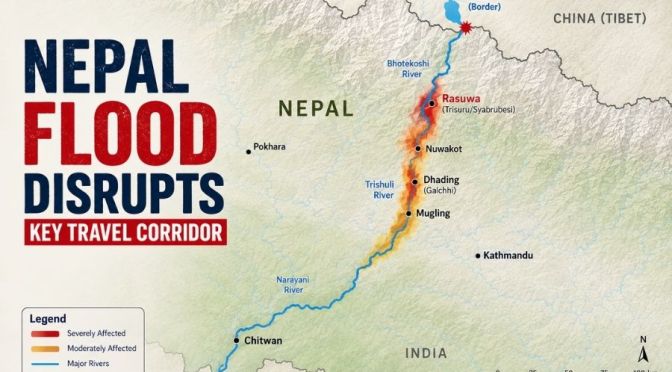
The affected area follows the Bhote Koshi–Trishuli river corridor, extending from the Tibet (China) border through Rasuwa and towards Nuwakot, Dhading, Mugling, and Chitwan, according to the accompanying operational map.

Other tourism areas operating
The PATA Nepal Chapter has emphasised that the disruption does not extend across Nepal as a whole. Overland movements between Kathmandu–Pokhara and Kathmandu–Chitwan are operating normally, while Tribhuvan International Airport and all domestic airports are also operating normally.
Hotels, restaurants, and heritage sites in Kathmandu Valley are operating normally. The Everest and Khumbu region, including Lukla flights, as well as the Annapurna region and Pokhara, Chitwan and Bardiya, and Lumbini and the Terai are also reported to be operating normally.
With autumn recognised as Nepal’s principal trekking season, the PATA Nepal Chapter said the Everest and Annapurna regions, where the great majority of autumn arrivals travel, are outside the affected river system and were not in the flood path. It will provide further updates on operating conditions in the affected region as the situation stabilises.

Rahul Bhadana is a digital editor at TravTalk with experience spanning multiple content niches, with a strong focus on travel trade journalism and digital publishing. A graduate of Delhi University, his work covers editorial writing, content strategy and platform-led storytelling, supporting TravTalk’s digital growth and industry engagement. A technology enthusiast, he enjoys films, poetry and exploring new ideas across media and culture.