

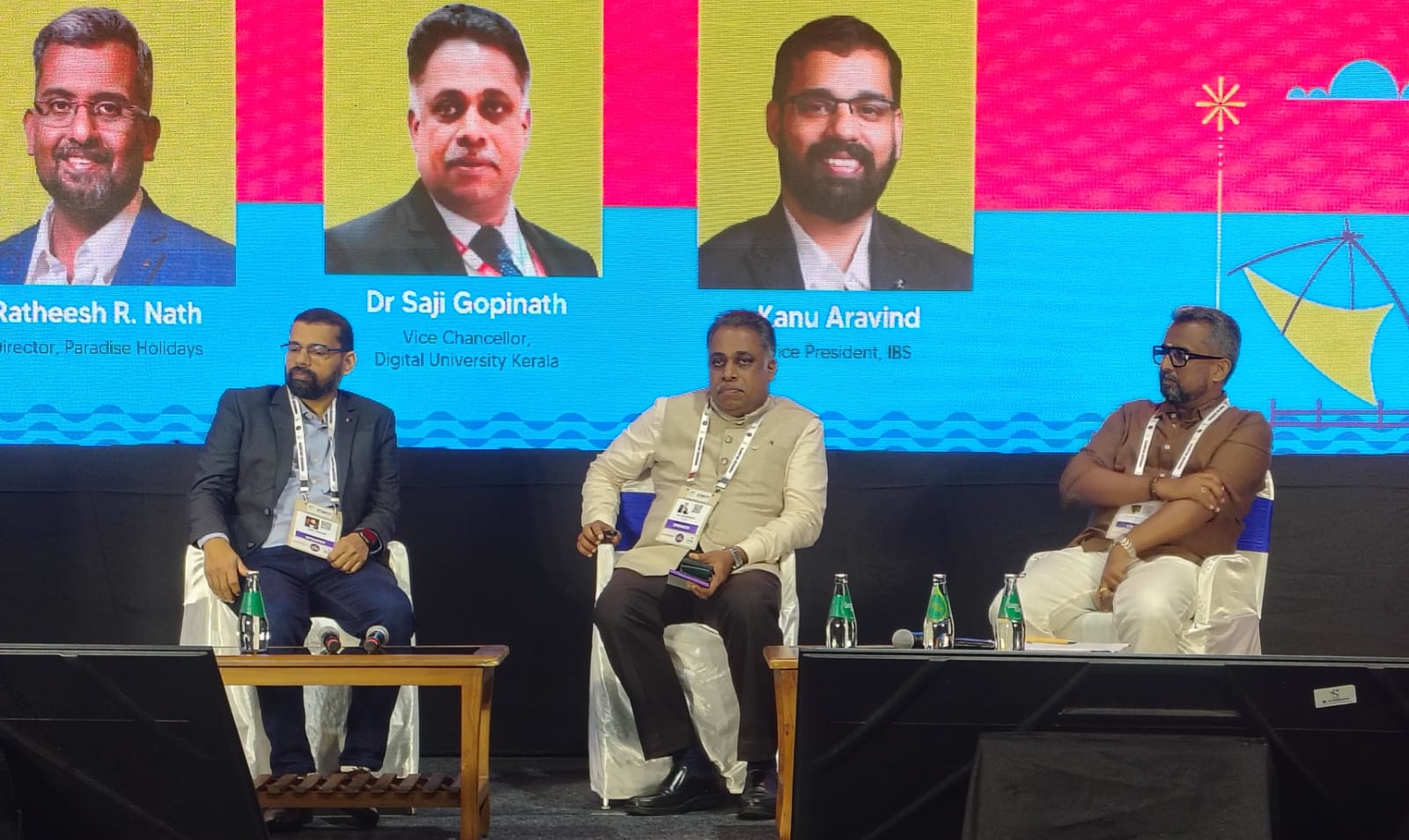
As artificial intelligence moves from being a supporting technology to becoming a core part of the travel journey, tourism enterprises will need to fundamentally rethink their business models, systems and processes to remain relevant, experts said at a panel discussion at Kerala Travel Mart (KTM) 2026.
The discussion assumed added significance as UN Tourism brought the AI agenda to the forefront of global tourism as part of the World Tourism Day 2026.
Participating in the KTM panel discussion on ‘Application of AI and Disruption by AI in Tourism Industry’, Dr Saji Gopinath, Vice Chancellor of Kerala Digital University, said AI was moving from the periphery of tourism businesses to the core of their operations. Rather than being used only to support existing functions, AI would increasingly influence the entire travel lifecycle — from dreaming and planning a trip to booking, experiencing and reviewing it.
He pointed to the evolution from websites and conversational interfaces to what he described as an “Acting layer”, where AI agents could make decisions and act on behalf of travellers.
Gopinath identified three levels of transformation — efficiency, effectiveness and new growth. While AI could make existing tasks dramatically faster, he said its larger potential lay in enabling businesses to undertake activities that were previously difficult or impractical, including better inventory optimisation and forecasting, and eventually redesigning processes and creating new business models.
He also cautioned that tourism businesses could no longer focus only on optimising their own websites. As travellers increasingly discover and transact through AI platforms, businesses would have to “go where the customer is” and make themselves visible across emerging AI-driven channels.
At the same time, Gopinath stressed that the growing role of AI would not make the human element less important. As technology takes over more transactional interactions, tourism professionals would need to bring greater empathy and human engagement into areas where machines cannot replicate the experience.
Later, speaking to TravelBiz Monitor, Dr Gopinath said that as the first digital university in the country based in Keralam, a state where tourism is second most important driver of the economy, the university would be taking pro-active steps to guide the AI transformation and help tourism industry to lead the way for the country. The Digital University has an MoU with the State Tourism to develop affordable solutions to make the state’s tourism AI ready, he said. “We are also training students of KITTS on some of these technologies,” he informed.
Kanu Aravind, Vice President, IBS Software, took the argument a step further, saying AI should not be treated simply as another technology upgrade. He said that the enterprises shouldn’t see AI as a disruptor, but an enabler. For this, the trade and industry required a “DNA change”, he said. The transformation should encompass capabilities, systems, processes and people.
According to Aravind, tourism businesses will need to develop ‘AI channels’ alongside their existing websites, mobile applications and social platforms. Discoverability itself is changing, with businesses having to look beyond conventional SEO towards approaches such as Generative Engine Optimisation (GEO) and Answer Engine Optimisation (AEO). Tourism enterprises need to make their products, services and systems sufficiently open and discoverable so that emerging AI platforms can find and surface them to potential travellers.
Aravind also highlighted the importance of context and authenticity, particularly for destination marketing. Kerala’s cultural experiences such as Kalaripayattu, Poorams, Ayurveda and North Kerala’s folk traditions cannot be reduced to literal translation; AI-driven discovery needs to communicate the experience and cultural context behind them.
Both speakers also underlined that AI adoption would require investment in people and processes, alongside technology. Arvind called for appropriate guardrails to prevent uncontrolled AI systems from creating operational or financial risks, while pointing to applications in fraud assessment, payment-risk analysis, revenue forecasting and revenue management.
Dr Gopinath also cautioned businesses about the criticality of guarding the guest data, privacy, consent and care while using AI platforms and tools, as India is set to implement the Digital Personal Data Protection Act (DPDP) Act, 2023, from May, 2027.
Both the experts observed that companies in the sector have to start earmarking certain budget for AI related systems going forward as many tools and services that come either free or at a subsidised rate might come at a cost as volume increases.
The panel discussion was moderated by Ratheesh R Nath, Managing Director, Paradise Holidays.