

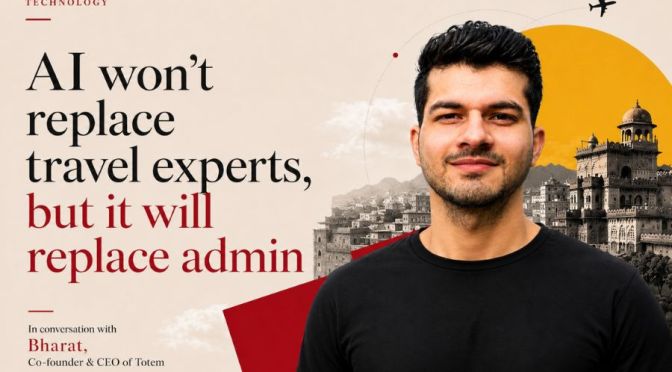
A traveller can book a hotel, flight, or holiday package in seconds. Yet for many DMCs and tour operators, transforming an enquiry into a proposal still involves navigating a maze of spreadsheets, emails, supplier contracts, and manual processes. As AI gains momentum across travel, companies such as Totem believe the industry’s next transformation will happen behind the scenes, not on the itinerary itself.
For years, online travel agencies (OTAs) have held a clear advantage in convenience. DMCs, meanwhile, have differentiated themselves through destination expertise, local knowledge, and highly personalised service. The challenge has been delivering that expertise at the pace modern travellers and trade partners increasingly expect.
 It is a gap that Bharat, Co-founder & CEO of Totem, believes artificial intelligence can help bridge.
Speaking to TRAVTALK, Bharat argued that AI’s greatest opportunity in travel lies not in replacing travel professionals but in removing the operational bottlenecks that have historically limited their ability to scale.
The hidden cost of fragmented workflows
Despite significant advances in travel technology, many DMCs continue to rely on a combination of CRM systems, itinerary builders, accounting platforms, spreadsheets, emails, and messaging applications to manage enquiries and bookings.
The result is a workflow that is often fragmented, repetitive, and heavily dependent on manual effort.
“We’ve spoken to hundreds of travel specialists across the world, from South America to the Middle East, Asia, and Europe. What we saw was just how much time travel specialists spend doing admin and execution rather than selling and advising,” Bharat said.
According to him, the issue extends far beyond inconvenience. Every time information is transferred between systems, businesses risk delays, errors, missed follow-ups, and lost opportunities.
“DMCs have to acknowledge every email, create an itinerary from scratch, open Excel to cost it, check with suppliers, draft emails, and then manage multiple revisions. That whole process sometimes takes up to a week.”
In a market where customers have become accustomed to instant responses and frictionless digital experiences from the likes of OTAs, such delays can have a direct impact on conversion rates and profitability.
“Slow responses affect conversion rates. Costly mistakes reduce margins. Poor follow-ups mean enquiries are lost. Manual admin means teams can handle fewer enquiries.”
The observation raises an important question for the travel trade: if expertise remains the industry’s greatest strength, why are its most experienced professionals spending so much time on administrative tasks?
Let AI handle the process

For Bharat, the answer is not simply adding another software layer to an already crowded technology stack.
Instead, he believes AI should become an operational coworker capable of managing tasks that currently consume valuable time.
“What we’re building is the end-to-end AI coworker that takes the enquiry, reads the client request, understands the requirements, creates a structured trip, prepares a digital itinerary and a costed proposal by reading supplier contracts and online rates while also managing the CRM and operations. Teams using Totem can respond to enquiries in minutes instead of waiting days. It’s a game changer.”
More broadly, he sees AI taking ownership of activities that add little strategic value but consume significant resources.
“Formatting, copying information, preparing documents, managing follow-ups, and updating records are where AI can be transformational.”
This marks a notable shift in how the industry views automation. Traditionally, technology has focused on helping travel professionals complete tasks faster. AI, however, is increasingly being positioned as a system capable of executing entire workflows.
For DMCs and tour operators, the implications are considerable. Faster proposal turnaround, fewer operational errors, more consistent follow-ups, and improved scalability will allow AI-enabled DMCs to dramatically increase market share, improve margins, and become impossible to compete with. More importantly, they will do this without adding headcount.
Human expertise remains the differentiator
Yet despite the excitement surrounding AI, Bharat is adamant that technology cannot replace the human qualities that define successful travel businesses.

Instead, he believes AI will amplify the capabilities of experienced professionals.
“What it will do is make the best DMCs and travel operators even more powerful.”
That distinction sits at the heart of the debate surrounding AI adoption. While machines may become increasingly effective at processing information and managing workflows, they cannot replicate years of destination expertise, relationship-building, creativity, or cultural understanding.
According to Bharat, those skills will become even more valuable as administrative burdens are reduced.
“Those destination specialists will spend much more time understanding what clients want, designing better trips, and using their local expertise to deliver a far superior service than their competitors.”
A chance to compete with OTAs
For years, OTAs and direct booking platforms have reshaped expectations around travel. Customers can search, compare, and book in seconds, and that level of convenience has changed what people expect from the entire industry.
For DMCs and specialist operators, the relevance is not only direct competition with OTAs. Many DMCs work through tour operators, travel agents, wholesalers, and other trade partners. But those partners are also under pressure to respond faster, produce better proposals, and deliver a smoother experience to their own customers.
Bharat believes AI can help close that gap.
“OTAs and direct booking platforms have won on speed and convenience. The B2B travel channel has always won on expertise, trust, personalisation, and service. AI gives the B2B travel industry and DMCs in particular a chance to deliver both.”
By automating the operational work behind each enquiry, from reading the request and building the itinerary to costing, proposal creation, CRM updates, and follow-ups, DMCs can respond faster without becoming generic.
The opportunity is not for DMCs to become OTAs. It is for the whole B2B travel channel to offer the speed and convenience customers now expect, while preserving the expertise, relationships, and personal service that make specialist travel valuable. This will create a whole new product category that is far superior to what OTAs and B2B channels currently provide.
If that happens, it will supercharge the entire B2B travel ecosystem, from DMCs and tour operators to travel agents and advisors.
Adoption will determine which DMCs win
While interest in AI continues to grow, Bharat believes many businesses still underestimate the scale of change underway.
One of the most common misconceptions, he said, is treating AI as a feature rather than a business transformation.
“Everything needs to be reimagined and built from the ground up with AI at its core rather than AI being layered on top.”
He also challenged concerns around accuracy, arguing that advances in AI models have significantly improved reliability when systems are grounded in trusted data sources.
“We’ve actually seen fewer mistakes when people use Totem than when they don’t. When AI is grounded in a DMC’s own supplier contracts, pricing rules, preferred hotels, and internal processes, it can reduce the manual copying and rekeying errors that often happen when teams move information between emails, spreadsheets, and documents”
More importantly, he believes waiting for the technology to completely mature and wait until others have implemented it could prove costly.
“If you wait until the technology has been implemented by your competitors, you’ve already missed the boat.”
According to Bharat, businesses that begin integrating AI today will gain an operational advantage that becomes increasingly difficult for competitors to replicate later.
The future of travel may be human-led and AI-powered
The conversation around AI in travel is often framed as a contest between people and technology. Yet the more compelling reality may be a partnership between the two.
It will be shaped by the companies that use AI to remove friction, improve responsiveness, and unlock the full value of human expertise.
For DMCs and tour operators seeking to stand alongside online channels, rather than compete on unequal terms, that shift could prove transformational.
As Bharat sees it, the goal is not to automate travel expertise. It is to automate the work that stops travel experts from doing what they do best.

Rahul Bhadana is a digital editor at TravTalk with experience spanning multiple content niches, with a strong focus on travel trade journalism and digital publishing. A graduate of Delhi University, his work covers editorial writing, content strategy and platform-led storytelling, supporting TravTalk’s digital growth and industry engagement. A technology enthusiast, he enjoys films, poetry and exploring new ideas across media and culture.