

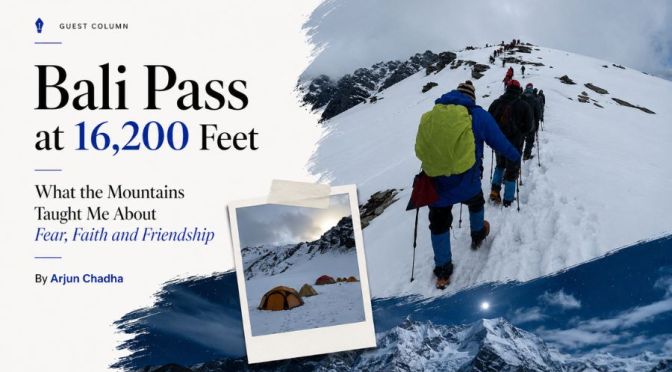
There is a moment on Bali Pass, just before the summit, where the ridge narrows to less than a metre. On your left, a sheer drop into a deep icy abyss. On your right, the same. Fresh snow underfoot. Clouds so thick you cannot see where the mountain ends and the sky begins. One misplaced step in either direction and you are gone.
By Arjun Chadha
I stood there in the grey silence at 16,200 feet, moving carefully, breathing deliberately, and thought: this is exactly where I am supposed to be.
The Trek Nobody Was Sure Would Happen
 I came to Bali Pass with two sources of nervousness, not one.
The first was personal. This was my first difficult-grade Himalayan trek, undertaken after a gap of one full year. I had done Buran Ghati before, so I knew high altitude, I knew cold camps and frozen mornings, but Bali Pass carries a different reputation. A reputation that is entirely earned.
The second source of nervousness was Uttarakhand itself. In the days leading up to departure, the state was under a red alert. Torrential rain, landslides, and warnings. Every morning, I checked the forecast, and every morning it said the same thing: rain, rain, rain. On departure day, 29 May, the forecast for Sankri showed 100% precipitation. Not a chance of dry weather. A certainty of wet.
And yet at 6 AM on 29 May, sixteen of us gathered at Prince Chowk in Dehradun, loaded into vehicles, and drove north into the clouds.
The Team
Sixteen trekkers. A mix of ages, cities, professions – all from across India, all united by the same quiet desire that brings people to high places.

Among them was Rahul, my batchmate from Delhi School of Economics, one of my closest friends, and the ideal trek companion: someone who knows when to push you and when to simply walk beside you in silence. On the hardest days, and there were hard days, we pushed each other forward without needing to say much.
There were trekkers in the group who had done Everest Base Camp. Others who had completed technical routes in Himachal. All seasoned, yet all humble about it. The conversations on the trail were extraordinary, from stories of past expeditions, careers, families, the quiet reasons people leave comfort behind and walk into mountains. Manish Sharma, in particular, kept the mood light on the hardest stretches with a gift for conversation and timing that should be bottled and sold at base camps. On the days when we were not short of breath, we sang.
Rain, Every Single Day!
 The forecast was not wrong. It rained on Day 1. It rained on Day 2. It rained on Days 3 and 4. Hailstorms swept through campsites without warning. Trails turned to rivers. Everything was perpetually, stubbornly wet.
And yet the team at Trek The Himalayas, our organisers, never wavered. Every day, through every weather alert, they found a way forward. On days when cancellation felt inevitable, they found a window, and we walked through it.
On Day 4, our longest trekking day at 16 kilometres and 23K+ steps, we reached Ruinsara Tal. The glacial lake at 11,800 feet sits in one of the most quietly beautiful amphitheatres in the Garhwal Himalaya. Snow peaks ring it on three sides. The lake itself mirrors a sky that, on that particular evening, was entirely clouded.
Bali Kol: The Camp That Wasn’t Supposed to Be
On Day 5 at Odari camp, at 4,000 metres, something happened that nobody planned for.
A few of us stepped outside our tents past midnight. The sky had cleared completely, the first time in days. Stars stretched from horizon to horizon. And then, as eyes adjusted to the darkness, there it was. Swargarohini. The mountain associated in Hindu tradition with the Pandavas’ final ascent towards heaven, standing silently above the valley in the moonlight.
No cameras. No crowds. No distractions. Just a handful of trekkers standing beneath a mountain steeped in centuries of myth, at 12:50 in the morning, in complete silence.

The next day, we were scheduled to arrive at Bali Kol, the high camp at 4,600 metres, but the campsite was completely buried under fresh snow. This was the moment when three options were seriously on the table.
Option A — Cancel entirely. From here, we could retrace the entire route back to Sankri and descend safely. A respectable outcome. Not the summit, but safe.
Option B — Skip the camp, go straight over. The sleeping bags and tents already at Bali Kol were completely submerged in ice and soaked through. We could march from Odari directly to Bali Kol, take a brief layover without sleeping, and immediately continue to the summit, combining two days into one brutal push. Having now experienced each of those legs separately, I can say with certainty: this would have been next to impossible.
Option C — The most doubtful, and the most ideal. Find a way to actually sleep at Bali Kol, recover, and do the summit properly the next morning.
What made Option C possible was a decision that deserves to be written about more than the summit itself. The TTH team called for extra porters, immediately and without fanfare and arranged for our dry, warm sleeping bags to be physically carried up from Odari to Bali Kol. Then, in the one hour of weak sun that appeared that afternoon, they worked to dry the tents sufficiently to make them habitable.
One hour of sun. Extra porters. Dry sleeping bags arriving at 4,600 metres by human effort alone.
 That is what stood between us and turning back. Not our fitness, not our gear, not our determination, though all of those mattered. It was the quiet, extraordinary competence of the people organising this trek.
That evening, in the red dining tent, the trek leaders gathered us for a meditation session. Hands in mudra position, eyes closed, the tent glowing red around us at 4,600 metres. I have been practising Buddhism for over 15 years, and I will say plainly: it was one of the most powerful meditation sessions I have experienced anywhere. The altitude, the uncertainty, the collective stillness, it worked. I also managed to chant my target of 1 hour every day, regardless of the circumstances.
 That night, I lay in full layers in my sleeping bag, too high to be warm, too alert to be nervous in the usual way. My oxygen levels were, unexpectedly, good. I chanted quietly in my mind, for determination, for calm, for the clarity to overcome fear when the moment came. I slept. At 3 AM, we woke. Porridge. Micro-spikes. Headlamps.
At 4 AM sharp, we stepped out into the dark.
Summit Day: The Ascent
The approach to the pass is a long, relentless snow climb. In the grey pre-dawn light, with headlamps cutting into cloud, the scale of what we were ascending was both terrifying and exhilarating.
 The word I keep returning to for that morning is exhilaration. Not relief – that came later. Not triumph – that came at the top. Just a clean, bright feeling of being completely awake and completely present in a way that ordinary life rarely permits.
Halfway up, I turned and took a selfie with Rahul. We were both smiling — properly, fully smiling — on a near-vertical snow face at 4,800 metres in sub-zero temperature. That, in itself, is the trek in a single image.
The Knife Ridge

Just before the actual summit, the mountain narrows to a knife edge. Not metaphorically, literally. The snow ridge at the top of Bali Pass is no more than a metre wide. On both sides: a sheer drop into deep, cloud-shrouded, icy nothing. Fresh snow covers every surface. Footprints from those ahead the only guide.
You walk it one step at a time. You do not look down, not because of fear exactly, but because there is nothing to see. The clouds had swallowed both valleys entirely. You had no sense of how far the drop was. Which, in retrospect, was a mercy.
I thought about the Ibex and Himalayan Thar that navigate terrain like this as a matter of daily life. We were doing it once, in borrowed microspikes, with trekking poles and racing hearts. They are born knowing how.
 The Summit
At 16,200 feet, with clouds on all sides and snow underfoot, the trek leaders led a prayer.
I am not going to try to describe that moment fully, as some experiences resist the flattening that description requires. Sixteen people at the top of a pass that had tried to cancel itself every day for a week. A prayer offered to the mountain, to the sky, to whatever it is that sits above both. The silence after it.
We held up the banner. We took the photograph. We were all there.

The Death Circuit
Nobody took a photograph on the descent.
I want to be precise about that. We had cameras. We had phones. Nobody reached for them.
The descent from Bali Pass toward Yamunotri is known, among those who have done it, as the technical crux of the trek. A 60-degree slant. Narrow paths no wider than six inches, carved into loose scree and permanent snowbeds. Rope sections where the alternative to holding on is a fall that ends very far below. Cloud cover so complete that the valley depth was invisible, which was, again, a mercy.
On one side, a near-vertical mountain wall. On the other hand, a steep drop disappears into the valley below. Between them, a path perhaps one or two feet wide in places. The challenge was not simply physical. A voice whispered constantly: What if you slip? What if you lose your balance? What if this is where things go wrong?
The descent did not ask whether I could walk across a narrow ledge. It asked whether I could manage the voice telling me that I couldn’t. The answer, as it always is in the mountains, was to focus on the next step. Then the one after that. Then the one after that.
Some moments are beyond documentation. The death circuit is one of them.
What I Brought Back
87.67 kilometres covered over 8 days. 1,26,602 steps. 126 hours of active movement. But the numbers are the least of it.
I came back with the memory of Ruinsara Tal in the mist, with wild horses grazing at the water’s edge as if humans were entirely optional. I came back with the image of sixteen people meditating at 4,600 metres in a red tent, hands open, eyes closed, the mountain outside. I came back with a memory of Swargarohini, the Pandavas’ mountain, standing silver and still above the valley while the rest of the world slept. I came back with the knowledge, not the belief, that a body and mind properly prepared can go further than fear suggests.
What the mountains served us: Jalebi at Bali Kol camp, at 4,600 metres. Gol Gappe at Lower Dhamni after the descent. I am not sure anything has ever tasted better.
I came back with renewed respect for Trek The Himalayas, whose team made this possible through seven days of relentless rain. The decisions they made, the care they took, the food they somehow cooked at altitude: none of this is trivial.
And I came back with a different understanding of Yamunotri — the sacred headwaters of the Yamuna that we descended toward after the pass. Before this trek, I understood it as a pilgrimage destination. After walking through days of weather severe enough to trigger a red alert, after standing beneath Swargarohini, near the ridge that the Pandavas themselves are said to have climbed, I began to understand why these places have inspired devotion for centuries. The Himalayas have a unique ability to make us feel small. And in that smallness, perhaps we become more receptive to something larger than ourselves.
“The journey itself is the teacher.”
Train hard, both physically and mentally. This trek challenges both.
The mountain does not negotiate. But it does reward.
The Trek at a Glance
| Day | Route | Altitude | Distance | Steps |
| 1 | Dehradun → Sankri | 1,950 m | 6.09 km | 9,179 |
| 2 | Sankri → Dharkot Camp | 2,400 m | 12.76 km | 17,491 |
| 3 | Dharkot → Devsu Bugyal | 3,100 m | 13.72 km | 20,019 |
| 4 | Devsu Bugyal → Ruinsara Tal | 3,600 m | 16.07 km | 23,130 |
| 5 | Ruinsara → Odari | 4,000 m | 8.80 km | 12,938 |
| 6 | Odari → Bali Kol | 4,600 m | 8.79 km | 12,704 |
| 7 | SUMMIT + Descent to Lower Dhamni | 4,950 m | 12.07 km | 17,696 |
| 8 | Lower Dhamni → Janki Chatti → Dehradun | 2,700 m | 9.37 km | 13,445 |
| Total | 87.67 km | 1,26,602 |
Trek organised by Trek The Himalayas — trekthehimalayas.com
