
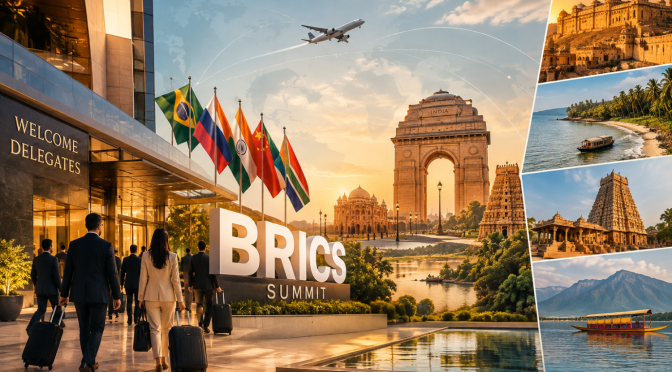
The BRICS Summit, India has left a broader demand footprint across India’s travel and hospitality sector, with Delhi-NCR emerging as the immediate beneficiary while business, MICE and leisure demand also extended into destinations such as Goa, Rajasthan, Odisha and the Northeast.
For hotels, the Summit demonstrated how large international events can generate demand beyond the host city, particularly when business travellers combine meetings with leisure stays. It also highlighted the growing role of connectivity in determining where this incremental demand eventually flows.
“During the BRICS Summit, we saw a 65% upsurge in bookings, highlighting the potential for large international events to drive both inbound travel and hotel demand,” said Rahool Macarius, Market Managing Director – Eurasia, Wyndham Hotels & Resorts. He added that Delhi, Mumbai and Bengaluru remain key business and MICE hubs, while Goa, Jaipur and Kochi are positioned to benefit as travellers extend business trips into leisure stays.
Delhi-NCR sees event-led hotel demand
Delhi remained the strongest demand centre around the Summit, with the event generating incremental accommodation requirements across the National Capital Region. At Ramada Encore by Wyndham Dwarka Expressway, occupancy for September 12–15 was tracking at 65%, according to Macarius, reflecting event-led demand in the market.
The impact was particularly visible in branded accommodation, with Wyndham also reporting travel by Wyndham Rewards members to Delhi during the Summit period. Macarius said the event reflected increasing demand for branded midscale and upscale accommodation, alongside expectations for convenience, flexibility and seamless travel arrangements.
 The luxury segment recorded a similar demand surge. According to Randhir Gupta, VP – Commercial & Business Development, Mayfair Hotels & Resorts, the BRICS International Summit increased enquiries for premium accommodation, corporate travel, conferences and longer stays.
“Delhi has clearly been the strongest market, with luxury hotels reporting very high occupancy, limited availability and substantial tariff increases ahead of the Summit,” Gupta said.
Demand spills beyond the capital
The post-Summit picture also points to a wider opportunity for destination-led travel. Mayfair reported stronger demand at Mayfair Spring Valley Guwahati, while its properties in Bhubaneswar, Siliguri, Darjeeling and Gangtok also saw the impact of business, MICE and leisure movement. Its Mayfair On Sea property in Morjim, Goa, similarly benefited from leisure demand.
For the travel trade, this indicates that international events can create secondary demand in destinations that are not directly hosting the event. Business travellers arriving for meetings can subsequently add leisure components, while accompanying travellers can generate demand for hotels, experiences and local circuits.
Connectivity becomes the next growth lever
The Summit has also reinforced the importance of connectivity in determining where future event-led demand can travel. Wyndham is tracking new and expanded airports, airline routes, capacity additions and highway development as indicators of emerging travel corridors.
Macarius said the company’s expansion strategy is increasingly linked to these connectivity trends, with airport-led development becoming an important factor as Wyndham works towards its target of around 200 hotels in India by 2028.
The larger implication for India’s tourism and MICE ecosystem is that international events need not remain concentrated within Tier I cities. While Delhi, Mumbai and Bengaluru will continue to anchor large business events, improved connectivity could distribute demand across Tier II and Tier III destinations with established cultural, heritage and leisure propositions.
The BRICS Summit, therefore, offered more than a temporary occupancy spike. Its demand patterns provide a snapshot of how international business events can connect MICE, inbound tourism, hospitality and leisure travel, with connectivity determining how far that impact can spread across India.

Shreya Bansal is a reporter at TravTalk India, covering the travel and tourism industry. She brings a keen eye for emerging trends, trade developments, and the stories shaping the travel landscape. Through in-depth reporting and on-ground insights, she connects industry stakeholders with news that matters. Beyond travel, Shreya has a growing interest in the premium lifestyle space, particularly the world of fine jewellery and is eager to explore the craftsmanship, culture, and commerce that define luxury living.