
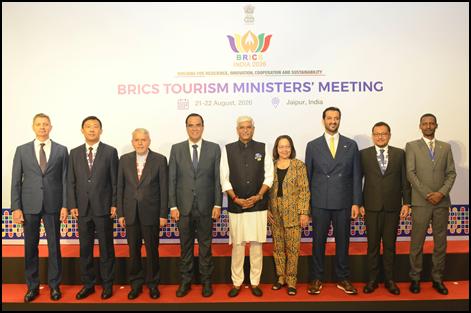
Key decisions on strengthening cooperation in the tourism sector among BRICS nations were taken at the BRICS Tourism Ministers’ meeting held in Jaipur on Friday, culminating in the adoption of the Jaipur Declaration aimed at establishing a framework for practical collaboration. According to an official release, Union Minister for Tourism and Culture Gajendra Singh Shekhawat said the theme for the tourism track under India’s BRICS presidency is “Building for Resilience, Innovation, Cooperation, and Sustainability.”
During the Tourism Working Group meeting held in Jaipur on August 19-20, discussions centred on four key priorities: artificial intelligence and tourism, sustainable and responsible tourism, skill and capacity building in the tourism sector, and tourism exchanges alongside seamless travel facilitation. Shekhawat said the Jaipur Declaration, formulated to foster tourism cooperation among BRICS nations, establishes a comprehensive framework for practical collaboration, emphasising the responsible use of artificial intelligence, human-centric tourism, capacity building, tourism investment, the exchange of data and best practices, and the strengthening of people-to-people ties.
Discussions also focused on making travel more seamless across BRICS nations. While visa regimes remain determined by individual countries based on their own regulations, member nations are working collectively to minimise inconvenience and maximise convenience for travellers. Shekhawat noted that India’s e-visa system already allows tourists from many countries to apply online from the comfort of their homes or offices, serving as a model for streamlined travel facilitation.
The Union Minister also highlighted the rapid growth of domestic tourism in India, noting that the number of domestic tourist visits has more than tripled over the past decade, driven by the country’s geographical and cultural diversity. On the subject of sustainability, he observed that many major global tourist destinations are currently facing environmental and sustainability challenges linked to overtourism, underscoring the need to balance tourism development with responsibility toward local communities, the environment and natural resources. He added that efforts are underway to strengthen India’s Destination Management Organization (DMO) system and implement it at key tourist destinations, drawing on lessons learned from Ekta Nagar.
Shekhawat also stressed the importance of building a skilled workforce for the tourism sector, noting that cooperation among BRICS nations would be enhanced to train young people and tourism professionals in line with evolving technologies and changing traveller needs. He said the Jaipur Declaration paves the way for advancing tourism investment, developing diverse tourism products, exchanging data and best practices, and fostering cultural cooperation—including through the exchange of artists and cultural groups, as well as the preservation of shared cultural heritage among member nations.
As part of the event, foreign delegates attending the meeting in Jaipur were introduced to Rajasthan’s rich heritage and culture, visiting prominent attractions including Hawa Mahal, City Palace and Amer Fort. Delegates were also given insight into Rajasthan’s traditional arts and crafts, including Bagru printing, Meena weaving, lac bangle making, and handicrafts made from clay and paper. The Ministry of Tourism said this cultural showcase offered BRICS delegates a glimpse of “Incredible India” and Rajasthan’s rich traditions.
Shekhawat said that for India, tourism extends beyond simply visiting monuments, serving instead as a powerful medium to showcase the country’s culture, traditions and diversity to the world. He expressed hope that hosting the BRICS tourism meetings in Jaipur would further strengthen the city’s and state’s position on the global tourism map, potentially leading to increased tourist numbers and investment in the years ahead. He also expressed gratitude to the Government of Rajasthan, Chief Minister Bhajanlal Sharma and Deputy Chief Minister Diya Kumari for their support in organising the event, adding that the primary objective of BRICS tourism cooperation is to link tourism with the broader economy, create employment opportunities, empower local communities, and bring people closer together across member nations.