
India’s aviation industry is preparing for its biggest expansion yet, with airlines investing in new aircraft, international routes, and strategic partnerships. But the big question is: Are there enough inbound visitors? Airline leaders say India’s next tourism leap will depend on destination marketing, collaboration, and seamless connectivity — not just adding more flights.
Nisha Verma
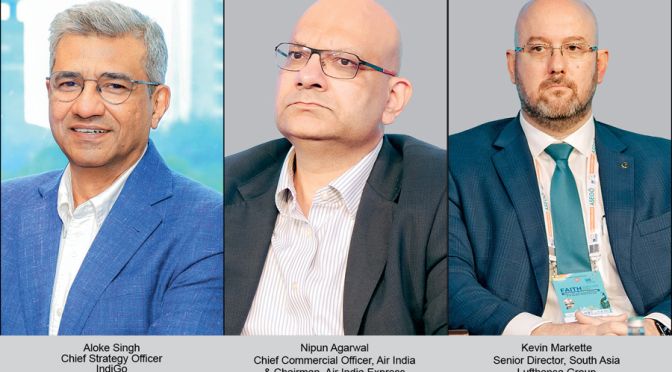
While Indian aviation industry has laid the foundation for growth, the country now needs to focus on selling the destination, improving the traveller experience, and building stronger partnerships across the tourism ecosystem, feel industry leaders. Aloke Singh, Chief Strategy Officer, IndiGo, said, “Tourism and aviation are essentially two sides of the same coin. If you go back in time, aviation as an industry has put many Indian cities on the global map, and all airlines have contributed to that. We have also put a very large number of global destinations on the Indian outbound map. So, there is no doubt about the synergies that exist between aviation and tourism.”
Speaking at the FAITH Conclave 2026, Singh said the real concern was the imbalance between different travel segments. “Outbound has outpaced inbound. There was a time when the inbound was bigger than the outbound. Domestic has been booming, but the inbound has stayed stagnant. Even within the FTAs, it is the pure touristic leisure that seems to have shrunk over the last 8–10 years, which is the fundamental issue that we should be talking about,” he added.
Echoing that sentiment, Nipun Agarwal, Chief Commercial Officer, Air India and Chairman, Air India Express, said that India possesses every ingredient to become a leading tourism destination but has yet to market itself effectively. “We have the assets, which include mountains, beaches, temples, hospitality, culture, and everything as a country. But the challenge is that airlines are selling seats, hotels are selling rooms. We are not selling our destinations and our experiences,” he said.
Capacity is not a challenge
The panellists agreed that aviation capacity is no longer the biggest obstacle. Kevin Markette, Senior Director, South Asia, Lufthansa Group, said India has become central to the group’s long-term strategy. “India is now also our second largest intercontinental market anywhere in the world, having overtaken China in terms of number of frequencies to India. Currently, we are looking at roughly 11 flights a day coming into India from our four hubs in Europe. We don’t see India just as a market that we fly to, but as a strategic focus market,” he underlined. Singh pointed out that India’s aviation ecosystem has expanded dramatically over the past decade. “The capacity has doubled. The next decade, the capacity is going to double again. Indian carriers today sit on 1,700 aircraft orders. This is the world’s largest order book. I don’t think connectivity per se is the bottleneck,” he emphasised. Instead, he believes the focus should now shift towards policy reforms and making travel more seamless.
Destination marketing
The need for collective destination promotion turned out to be a recurring point throughout the discussion. Agarwal argued that airlines alone cannot build tourism demand, saying, “Rather than marketing airlines or hotels, we need to market the country, both domestically and internationally. We need to improve customer experience, do more marketing, and improve connectivity. If we do these three things, the numbers can move up very rapidly.”
Singh also called for closer coordination across the ecosystem. “We have to work together — the airports, the airlines, the stakeholders, the policy makers. If you look at the successful models, it integrates everything together. Certainly, we should be looking at investing more, talking about the joint promotional efforts, and working together.”
Travel trade matters
The panel unanimously agreed that travel agents remain integral to tourism growth. Agarwal said, “A bulk of the bookings are still coming from the offline channel. Whether it is NDC or any other technology, that is just a pipe. That is not displacing the offline channel. Offline channel is active and vibrant and will remain so in years to come.” Singh added, “There is certainly room for both.” Markette concluded by saying, “To us, it makes no difference what pipe is used. The relationship with the travel community and the airlines is indispensable.”