
India has the potential to build a USD 3 trillion tourism and hospitality economy, but unlocking that opportunity will require a massive expansion in hotel supply, easier access to capital, better last-mile connectivity, new destinations and a more coordinated national tourism strategy, said Puneet Chhatwal, Managing Director & Chief Executive Officer, IHCL (Taj Group).
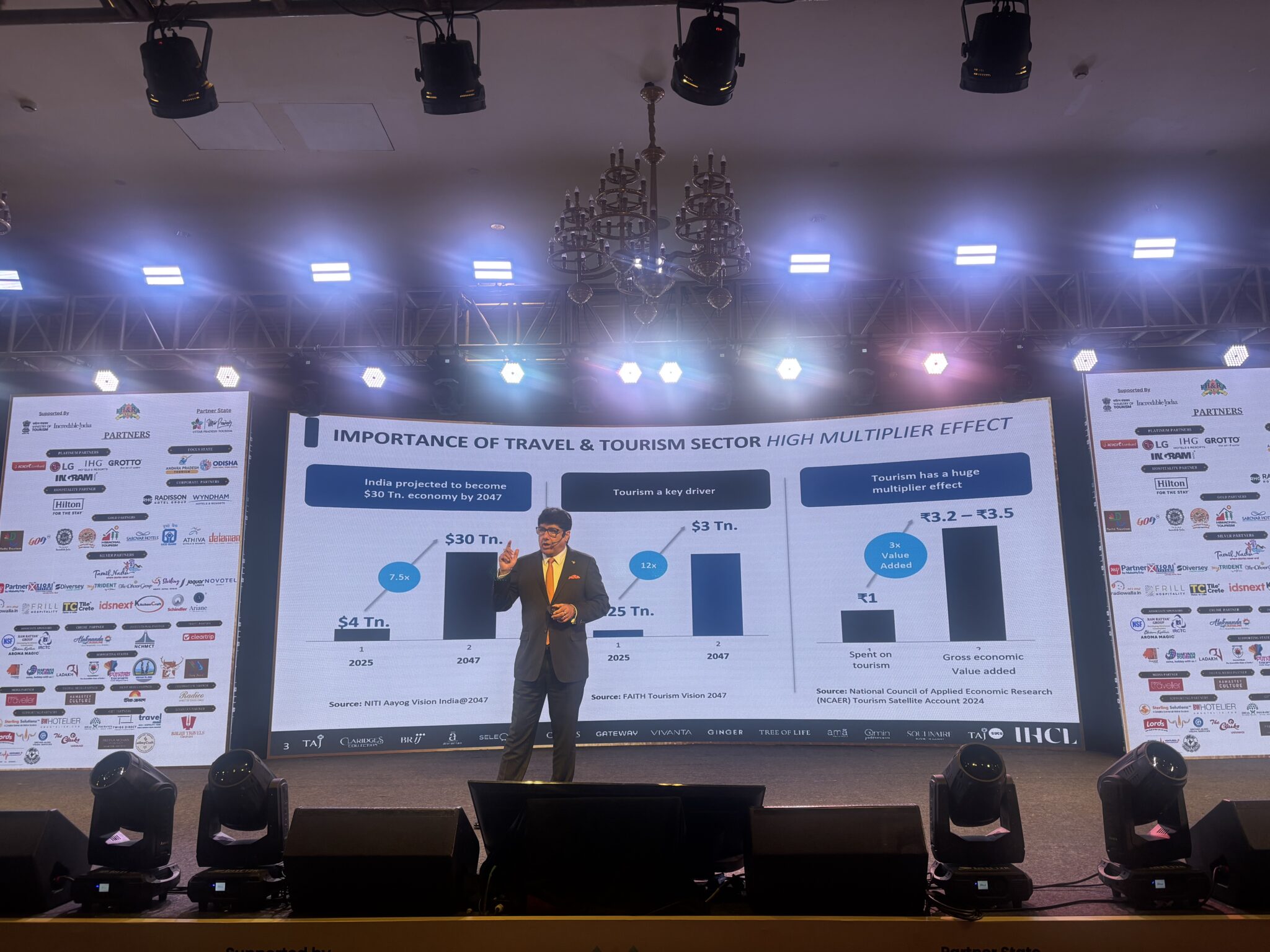
Addressing the 56th FHRAI Annual Convention at Taj Ganges, Varanasi, Chhatwal said tourism and hospitality could account for 10% of India’s projected USD30 trillion economy, compared with an estimated USD250 billion contribution today. He said every rupee invested in the sector generates around INR 3.2–INR 3.5 in economic value, making tourism one of the country’s strongest engines of economic activity and employment.
“If 10% was to come from tourism and hospitality, that is USD3 trillion, and we today stand only at USD250 billion,” Chhatwal said, underlining the scale of the opportunity.
He said India’s economic expansion is already driving a structural change in domestic consumption, with rising spending power creating stronger demand for leisure, travel and hospitality. “For the first time India is experiencing a structural shift in the way it consumes,” he said.
Room shortage
Chhatwal, however, said India’s ability to capture this demand is being held back by a severe shortage of quality accommodation.
He pointed to Varanasi as a live example, saying large conventions and events can quickly exhaust the city’s hotel inventory, forcing visitors to stay in surrounding destinations.
The supply challenge is not limited to Varanasi. Chhatwal said India could require around two million additional hotel rooms, while the country’s branded room inventory remains far below what is needed to support the next phase of tourism growth. The industry, he added, could require around INR 1 lakh crore of capital to create the necessary capacity.
“Capital will not come if the returns are not attractive,” he said, making a direct case for improving the financial viability of hotel projects.
According to Chhatwal, expensive land, high financing costs, multiple approvals and expensive utilities are collectively making hotel development less competitive than alternative investments.
“If land costs are among the highest, projects require more than 70 permissions, infrastructure status benefits are unavailable, and utility costs remain high, it becomes difficult for the sector to deliver competitive returns,” he said.
He also pointed to the industry’s tendency to demand lower hotel rates while dealing with rising construction and land costs. “Make larger rooms, more expensive land, and lesser rent. So this will not work,” Chhatwal said.
UP emerges as a major tourism opportunity
Chhatwal highlighted Uttar Pradesh as one of the clearest examples of tourism’s economic potential. He said the state’s spiritual tourism ecosystem, stretching across Prayagraj, Varanasi, Mathura and Vrindavan, could significantly increase tourism’s contribution to the state’s GDP.
He said Uttar Pradesh had recorded 156 crore tourist visits, with more than 90% driven by domestic travellers, describing the scale of domestic tourism as a structural trend rather than a temporary cycle.
“This is not going to come in cycles and go away. This is a trend. There is a structural shift,” he said.
IHCL itself has expanded its commitment to Uttar Pradesh, with Chhatwal stating that the group has a portfolio of around 62 hotels in the state, with a significant number in the pipeline. He also pointed to new and expanded Taj properties as part of the group’s investment in the state’s tourism infrastructure.
Spread tourism
Chhatwal said another structural weakness is the concentration of leisure tourism in a limited number of destinations.
“Today’s 75% of leisure tourist activity is limited to 15 to 20 destinations,” he said, calling for faster development of new tourism clusters.
He urged the government to accelerate the development of the 50 new destinations announced in the Union Budget, arguing that dispersing tourism demand would create new investment opportunities while reducing pressure on established destinations.
“Developing new destinations is a key. If we all keep going to the same spiritual sector, that’s not going to help,” he said.
He also called for a multi-activity tourism ecosystem that combines conventions, leisure, sports, adventure, wellness and other experiences.
Connectivity remains a major bottleneck
While acknowledging the government’s significant investments in roads, airports and railways, Chhatwal said further improvements in last-mile connectivity would help strengthen access to tourism destinations.
“Our last mile remains. So there is this challenge of connecting,” he said, advocating the development of satellite towns around major tourism centres where infrastructure and hotel capacity are already under pressure.
Reliability, he said, is as important as infrastructure creation. He cited his own travel disruption to Varanasi, where a cancelled flight forced him to alter his onward travel plans.
“We need more airports. We need better connectivity. We need more reliability of the infrastructure,” he added.
High financing costs, expensive land remain structural barriers
Chhatwal said hotel development in India faces a double disadvantage: land is expensive and the cost of capital is high.
He noted that institutional funding for hotel projects remains limited compared with markets in Europe, where project financing can be available at substantially lower rates. He also said land can account for more than half of the total project cost in some Indian developments, far above what he considers economically viable for a hotel project.
The sector also operates within a diverse policy environment, with tourism being largely a state subject and regulations, permissions and incentives varying across states, he said.
Six-point action plan
Chhatwal outlined a six-point framework for unlocking India’s tourism potential: planning, place, people, policy, processes and promotion.
On planning, he called for seamless connectivity, responsible tourism and the development of new destinations.
On people, he highlighted India’s demographic advantage but warned that the country must convert its young workforce into a skilled hospitality workforce. IHCL, he said, has established 83 skilling centres over the past two years, including seven in Uttar Pradesh.
“We have the people, but we don’t have the skilled people,” he said, calling for greater collaboration with international hospitality companies, formal training and global partnerships.
On policy, Chhatwal reiterated the industry’s long-standing demand for infrastructure status, a national tourism policy and a national tourism board, along with better Centre-state coordination.
He also called for a more coordinated approach to promoting India overseas, suggesting a unified India Pavilion to present the country’s tourism offerings under a common national narrative.
India needs to market itself harder
Chhatwal said India’s tourism ambitions cannot be achieved without a substantially stronger international marketing effort.
“We need to market India. We need to redefine the narrative for India. We need to communicate as much as we can,” he said.
He cited the earlier Incredible India campaign as an example of the impact a strong national tourism narrative can create, arguing that marketing expenditure should be treated as an investment rather than a discretionary cost.
According to Chhatwal, every additional USD1 million invested in tourism marketing could potentially generate 10,000 incremental foreign tourist arrivals and more than USD35 million in gross economic value, based on the calculations he cited.
Tourism as a jobs engine
The larger economic argument, he said, is employment. Chhatwal positioned tourism and hospitality as one of India’s biggest potential job creators, with direct employment generating additional activity across food supply, transportation, airports, logistics and other allied sectors.
“If each job creates six to eight as a minimum multiplication in other sectors, that’s your food supplier, that’s your airport rep,” he said.
He also called for greater emphasis on leisure, sports, adventure, health and wellness tourism, stating that India’s cultural heritage and natural assets give it the raw material to become one of the world’s most preferred destinations.
“Unlocking the tourism potential for India is our collective responsibility,” Chhatwal said, urging the industry and government to focus less on complaints and more on documenting, communicating and scaling the work already being done.
“Good work must continue, but we should also tell how much we do and document it somewhere,” he said.