

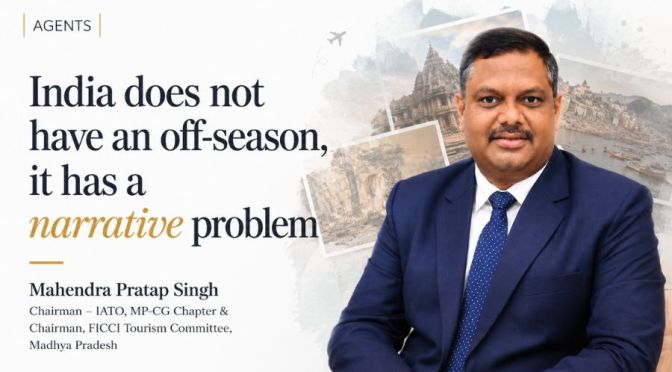
There was a time when the arrival of monsoon clouds signalled a collective sigh of resignation across India’s travel industry. Hotel occupancy charts would dip, tour operators would brace for lean months, and the entire sector would hunker down, waiting for winter to breathe life back into business. But something remarkable is happening. The rains are no longer seen as an adversary to tourism—they are becoming its unexpected ally.
“The perception of monsoon tourism has undergone a fundamental shift,” observes Mahendra Pratap Singh, Chairman – IATO, MP-CG Chapter & Chairman, FICCI Tourism Committee, Madhya Pradesh. “Earlier, the season was largely seen as a low-demand phase where businesses focused mainly on discounts and occupancy recovery. This mindset is changing with time.” And change it must, because today’s traveller is cut from a different cloth entirely.
The modern Indian traveller isn’t looking for bargain-basement deals during the off-season; they’re seeking something far more valuable—experiences that can’t be replicated under harsh summer sun or crowded winter skies. When the rains arrive, India transforms. Forests erupt in impossible shades of green, waterfalls that were mere trickles become roaring spectacles, and the chaos of peak-season tourism gives way to something more intimate and immersive.
“During the monsoon, landscapes transform completely, forests become more vibrant, waterfalls revive, and destinations feel more peaceful and immersive,” Singh explains. “Travellers are now seeking those experiences intentionally rather than travelling only because prices are lower.” This is the crux of the matter—monsoon tourism isn’t about survival anymore; it’s about opportunity. “If destinations are positioned properly, monsoon tourism can become an experience-led opportunity rather than a reluctant season,” Singh says.
A destination without an off-season
Perhaps the most persistent myth in Indian tourism is the notion that the country has a fixed travel calendar. Singh challenges this with characteristic directness: “India does not have an off-season. It has a narrative problem. Every month of the year, somewhere in this country, there is a view, a celebration, a flavour or a route worth travelling for. Our job is to stop hiding eleven of those months behind one,” he says.
The evidence is compelling. While winter continues to be the traditional peak, other seasons are staking their claim. Wildlife enthusiasts know that summer brings animals to waterholes in parched forests, offering some of the best sightings of the year. Spiritual seekers find solace in the rains, when temple towns take on a mystical quality. Food lovers track harvest festivals across states, while adventure travellers chase the monsoon trails through the Western Ghats.
“Wildlife, wellness, spirituality, festivals, food tourism, and nature-led experiences are helping extend travel across the calendar,” Singh notes. “Travellers today are also more willing to explore slower and more purposeful travel instead of limiting themselves to traditional holiday periods.” The pandemic may have accelerated this shift, but the underlying change is generational. Younger travellers especially are rejecting the rigid holiday schedules of their parents, embracing instead the freedom to travel when the mood—and the experience—calls.
“The opportunity for India now is to market each season differently, rather than treating only winter as the main travel window,” Singh emphasises. It’s a strategy that requires imagination and investment, but the rewards are substantial. A destination like Kerala has long understood this, positioning itself as a year-round paradise where each season offers something distinct. Others are following suit, discovering that the secret isn’t fighting the weather but celebrating it.
Domestic insurance a must
But as Indian travel expands across seasons and territories, a new conversation is emerging—one that Singh believes the industry can no longer afford to ignore. “Travel today has become increasingly uncertain. Weather disruptions, medical emergencies, road closures, flight cancellations, and baggage issues are as domestic as they are international. Domestic travellers face identical risks.”
Yet for most Indians, travel insurance remains something you buy only when the passport comes out. A domestic trip? That’s safe territory. Or so they believe, until a monsoon landslide blocks the only road to their hill station retreat, or a sudden medical emergency in a remote wildlife sanctuary requires evacuation, or a missed connection derails an entire itinerary.
“Many people continue to treat insurance as a foreign-trip formality,” Singh observes, “but even a short domestic trip can involve disruptions that unravel even the best-planned trips.” The financial stakes are higher than most travellers realise. A cancelled hotel booking, a last-minute flight change, or medical expenses in a city where you don’t have coverage can quickly turn a budget holiday into an unexpected financial burden.
Singh is unequivocal about the industry’s role: “As travel professionals, it is our responsibility to encourage travellers to protect themselves properly. Insurance today should be seen as part of responsible travel planning rather than a line item we cross out to save a few hundred rupees.” This isn’t about upselling; it’s about education. When a traveller’s carefully planned journey goes sideways, insurance isn’t an expense—it’s the lifeline that turns chaos into inconvenience.
“There are more scenarios than most travellers anticipate where domestic travel insurance becomes important,” Singh points out. “During the monsoon season, weather doesn’t negotiate with departure boards. In wildlife and remote destinations, medical emergencies or evacuation support may sometimes be required. Even lost baggage, sudden illness, or last-minute trip cancellations can create financial stress for travellers.”
The anecdotal evidence is mounting. “We have also seen situations where travellers had to shorten trips unexpectedly due to family emergencies or operational disruptions,” Singh adds. “In such cases, insurance provides reassurance and reduces the financial burden.” It’s the kind of reassurance that allows travellers to relax into their journey, confident that even if things go wrong, they won’t be left stranded.
“As the ambition of Indian travel grows, the importance of domestic travel insurance will continue to grow,” Singh concludes. And indeed, as more Indians explore their own country’s extraordinary diversity — from the snow-capped peaks of the Himalayas to the backwaters of Kerala, from the deserts of Rajasthan to the rainforests of the Northeast — the need for comprehensive protection becomes ever more apparent.
What emerges from Singh’s perspective is a vision of Indian tourism that’s maturing into its potential. The seasons are no longer obstacles but invitations. The traveller is no longer passive but purposeful. And the industry is finally recognising that its greatest asset isn’t a particular month or destination — it’s the unbounded curiosity of the people who want to discover their country.

With over 17 years of experience in the B2B travel and hospitality sector, she brings deep insight into travel trade dynamics, industry challenges and market developments. She holds an MA in English Literature and a Diploma in Journalism from the Xavier Institute of Communications, Mumbai, which underpin her strong editorial expertise. An avid nature enthusiast, she prefers outdoor and adventure-led travel, including hiking and trekking.