

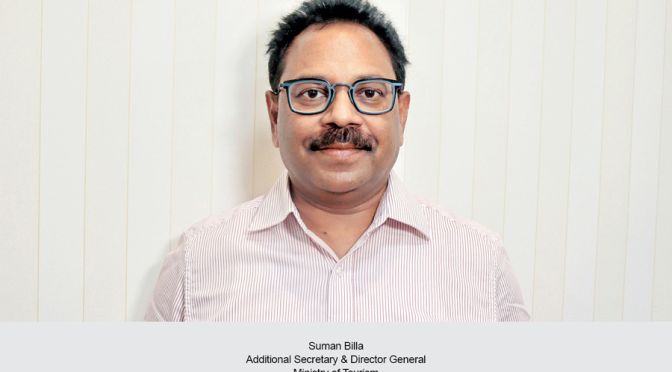
Calling the celebration economy an untapped engine of growth, Suman Billa, Additional Secretary and Director General, MoT, unveils a seven-point roadmap to help India build globally competitive wedding destinations.
Janice Alyosius
Convinced that the celebration economy is one of India’s greatest competitive advantages, Suman Billa unveiled a seven-point agenda to transform weddings into a strategic tourism and economic driver built on policy support, destination development, professionalisation, and sustainability. “We know that there is significant potential, but very little of that potential is converted into performance. We need to collaborate, have a game plan, and a clear roadmap, so that we can realise that potential,” Billa said. He added, “This wedding economy has the potential to create livelihoods for millions, and it can also become a large employment generator.”
Seven-point agenda
Recognise the celebration economy as a strategic sector: India must formally recognise the celebration economy as an important contributor to growth. This requires measuring its economic contribution, analysing its impact, and creating a dedicated policy framework that supports long-term development. “We need to recognise that this is a strategic economic sector, measure it, analyse it, and build a policy framework around it,” he said.
Build purpose-designed celebration destinations: Instead of focusing only on wedding venues, Billa urged governments to strengthen destination infrastructure through better connectivity, accommodation, public spaces, safety and cleanliness. He added, “The government’s role should be to build the destination and the industry must build experiences.”
Take weddings beyond traditional hotspots: He advocated expanding wedding tourism into emerging destinations, citing places such as Hampi, Khajuraho, and the Northeast as ideal for intimate celebrations. Doing so, he said, would spread tourism and create new economic opportunities for smaller regions. “When weddings happen in smaller destinations, they have the potential to transform local economies,” he claimed
Celebrate what is local: Weddings should showcase the destination rather than simply use it as a backdrop. Local cuisine, music, artisans, cultural performances, and communities should be woven into every celebration. “The idea is not just to use the destination as a backdrop but to showcase it at its authentic best,” he said.
Professionalise the industry: The sector, he said, needs skilled professionals, recognised standards, certification systems, and greater use of technology to improve service quality and customer confidence. “Professionalisation is very important. We need the right skill sets, standards, and certification so users can reach the right partners,” he underlined.
Make sustainability a core principle: Luxury and responsibility, Billa said, must go hand in hand as he called for reducing waste, encouraging local sourcing, and ensuring communities benefit directly from celebrations. “Without sustainability, luxury is meaningless,” he said.
Strengthen government-industry partnership: The final recommendation was closer collaboration between the public and private sectors. “The government should focus on creating infrastructure and destination development, while the private sector must focus on creating experiences, innovation, marketing, and excellence,” he said. Billa concluded that if these priorities are pursued collectively, the celebration economy could become one of India’s strongest growth engines. Beyond boosting tourism, he said, it can protect cultural heritage, create opportunities for MSMEs, encourage women-led entrepreneurship, and strengthen India’s soft power on the global stage.