
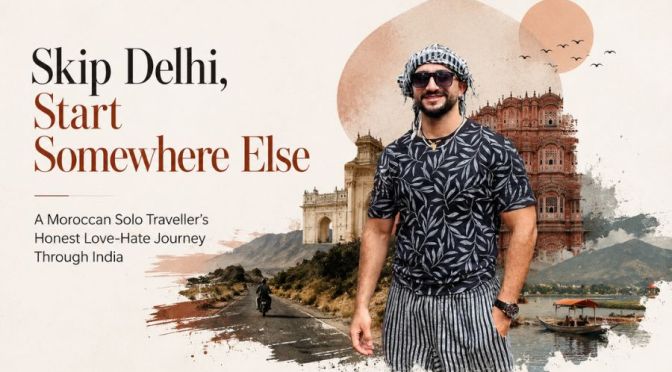
A Moroccan Solo Traveller’s Honest Love-Hate Journey Through India
What happens when a seasoned solo traveller who has explored 23 countries arrives in India with an open mind, a love for Asia, and a lifelong fascination with Bollywood, only to find himself questioning whether he should leave on day one?
Moroccan tourism educator Oussama Sayed’s journey is an honest, sometimes uncomfortable, yet deeply revealing look at India through the eyes of a foreign traveller, offering lessons that extend far beyond tourism.
India had lived in Oussama Sayed’s imagination long before he ever boarded a flight. The 30-year-old Moroccan tourism educator grew up with Bollywood songs, stories of Shah Rukh Khan, and even a family connection that traces back to an Indian great-grandmother. For him, India was not just another destination on a growing travel map that already included 23 countries. It was a place he felt connected to long before he arrived.
But when he finally landed in India as a solo traveller in August 2025, reality proved far more complicated than the colourful images he had carried with him. There was wonder. There was kindness. There was friendship.
There was also confusion, mistrust, relentless hustling, and a first impression that nearly pushed him onto the next flight out.
His story is not about India being good or bad. It is about what happens when a curious traveller arrives with an open mind and discovers a country of extraordinary highs and frustrating lows.
 The India he dreamed about
Like many Moroccans, Sayed’s first introduction to India came through Bollywood.
“Everyone in Morocco knows Bollywood,” he laughs. “People see an Indian and start singing Bollywood songs.”
But social media had painted a second picture. Alongside the colourful films were videos of chaotic streets, questionable street food, and endless warnings from other travellers. “When I told my friends I was going to India, they asked me if I was crazy,” he recalls. “But I wanted adventure. I didn’t want comfort. I wanted real life.”
So he packed his bags and set off alone.
A first day that almost ruined everything
His Indian journey began in Delhi. It did not begin well. Within hours of arriving, Sayed says his Indian journey began in Delhi. It did not begin well.
Within hours of arriving, Sayed says he was approached repeatedly by people questioning his hotel choice, redirecting him towards “tourist offices”, and attempting to convince him that his accommodation was unsafe or closed. What followed was a maze of conflicting information, unofficial travel agents, and pressure to buy packages he did not want.
“I went to five tourist offices in one day,” he says. At one point, he was even told that his hotel was closed, only to later discover it was open and operating normally.
The experience left him frustrated and cautious. “I had just arrived in the country. I didn’t know who to trust.”
For a solo traveller, that uncertainty mattered. When travelling alone, there is no companion to compare notes with, no second opinion, and no safety net. Every decision rests on instinct.
One frustration stood out more than any other. As a traveller who had visited more than 20 countries, Sayed could not understand why he was unable to simply buy a train ticket at the railway station. In most destinations, the station itself is the most trusted source of information for an arriving visitor. Instead, he found himself repeatedly redirected towards tourist offices and intermediaries, creating uncertainty at a time when he was still trying to find his footing in a new country.
“I just wanted to speak to someone who worked at the station,” he says. “Someone official that I could trust.”
 The problem with a bad first impression
What struck Sayed most was not the chaos itself. It was where he experienced it. Delhi was his introduction to India, and first impressions are powerful. Later in his journey, while staying in hostels and meeting other international backpackers, he discovered that many had similar stories. “We all agreed on one thing,” he says. “Skip Delhi.”
His criticism is not aimed at Delhi’s monuments, culture, or people. Rather, it is directed at the confusion that many first-time visitors face upon arrival. “When your first experience is being scammed, it changes everything.” The irony, he admits, is that later destinations presented many of the same challenges. The difference was that by then, he had adapted.
“After Delhi, I was prepared.”
Then India started winning him over
The turning point came in Jaipur. Almost immediately, the atmosphere felt different. He attended Friday prayers at a local mosque, spent hours talking with residents, and wandered through the city’s historic landmarks. At Jal Mahal, locals dressed him in traditional Rajasthani attire.
“They kept calling me Maharaja,” he says, laughing. He explored City Palace, Jantar Mantar, and Jaipur’s famous pink streets. More importantly, he found something he had been searching for since arriving. Genuine human connection.
“They didn’t expect anything from me. They just wanted a conversation.”
Agra changed everything
 If Jaipur softened him, Agra won him over completely.
The city that houses the Taj Mahal became the highlight of his Indian journey. He stayed in a hostel overlooking the monument and spent his evenings exchanging stories with fellow travellers. He made local friends. One even handed him the keys to his motorcycle.
“He gave me his motorbike, and we rode around Agra together.” For Sayed, Agra represented a different side of India. Less pressure. Less confusion. More warmth.
“People were nice. It was easy to move around. I really enjoyed my time there.” The experience reinforced something he would discover repeatedly throughout his travels in India. While infrastructure and systems sometimes frustrated him, personal interactions often left a lasting impression.
It was those moments of generosity and trust that began to outweigh his difficult first impressions.
India that social media never shows
One of the biggest surprises for Sayed was how often reality contradicted social media. The Indian rail network, for example, exceeded expectations. “Social media shows people hanging from trains and huge crowds everywhere. The actual train experience was surprisingly good.”
The Delhi Metro impressed him as well. “It was easy to use, and the staff were very helpful.”
These moments mattered because they challenged assumptions he had formed long before arriving. For years, much of his perception of India had been shaped by viral videos and online commentary. Experiencing the country first-hand revealed a far more nuanced reality.
Like many travellers, he discovered that destinations often cannot be fully understood through a screen.
Curious eyes everywhere
 As a Moroccan traveller with lighter skin and distinctive features, Sayed quickly discovered that he attracted attention. A lot of it. “People kept staring at me wherever I went.”
Strangers approached him with questions. Was he American? European? How could he be African and white? The attention was usually harmless curiosity, but for someone travelling alone, it could sometimes feel overwhelming.
“I never felt like I could just walk with my hands in my pockets and relax.” The experience offered another reminder of how cultural perceptions vary across regions and communities.
While the attention rarely felt threatening, it was a constant presence throughout much of his journey and something he had not encountered to the same extent in many other destinations.
For independent travellers, particularly those travelling solo, even well-intentioned curiosity can become exhausting when it is continuous.
The city that drowned beneath the rain
If Delhi tested his patience, Mumbai suffered from unfortunate timing. Arriving after spending time in Sri Lanka and the Maldives, Mumbai felt like a completely different world. Torrential monsoon rains meant that walking, exploring neighbourhoods, and discovering the city on foot became almost impossible.
Instead of immersing himself in the destination, Sayed found himself retreating to his hotel room and venturing out only for meals. “With the rain, waterlogging, and mud, there wasn’t much I could do,” he says. “I like walking and discovering a city. Mumbai didn’t allow me to do that.”
For him, Mumbai was less about the city itself and more about arriving at the wrong place at the wrong time of year. Unlike Jaipur and Agra, where he had been able to explore freely and connect with people, Mumbai remained largely out of reach because of the weather.
As a result, his experience of the city felt incomplete.
The food he never really discovered
One part of India largely remained unexplored for Sayed: its food. Years of negative social media content had already made him cautious. An unfortunate experience during a train journey, when he found a hair in a meal, reinforced those concerns.
Instead of diving into local cuisine, he chose familiar options.
McDonald’s.
Burger King.
Pizza Hut.
“Before booking a hotel, I checked if there was a McDonald’s nearby.”
For many travellers, that may sound like a missed opportunity.
For solo travellers, however, risk often feels different when you are completely on your own. A bout of food poisoning can derail an itinerary, disrupt plans, and create challenges that are far easier to manage when travelling with companions.
While Sayed acknowledges that he may have missed out on one of India’s greatest cultural experiences, his caution reflected the realities of travelling independently in an unfamiliar environment.
Where travel felt effortless
 Ironically, the destinations where Sayed felt most comfortable as a traveller were not in India at all. Both Sri Lanka and the Maldives delivered what he describes as a more intuitive and tourist-friendly experience.
In Sri Lanka, he quickly found himself travelling alongside other backpackers, sharing recommendations, discovering local food, and exchanging travel stories.
In the Maldives, the ease of travel, clear visitor infrastructure, and relaxed atmosphere created the kind of seamless experience many independent travellers seek. “The difference was that I always knew what to do and where to go,” he says.
His comparison is not intended as a criticism of India. Rather, it highlights the different expectations and experiences travellers encounter across destinations. While Sri Lanka and the Maldives felt immediately accessible, India often demanded more patience, adaptability, and confidence from visitors.
For some travellers, that complexity can be intimidating. For others, it can become part of the adventure.
Why he wants to return
Despite everything, Sayed is clear on one thing. He wants to come back. Not because the trip was perfect. Because it wasn’t.
He knows bad weather affected Mumbai. He knows some poor choices influenced his experience. He knows there are entire regions of India he has yet to discover.
Most importantly, he believes the India he loved deserves another chance. “Jaipur and Agra were amazing.” And perhaps that is the most important takeaway from his journey.
India frustrated him.
India surprised him.
India challenged him.
Yet somewhere between the chaos of Delhi, the friendship of Agra and the colours of Jaipur, the country left enough of a mark to make him want to return. For a solo traveller, that may be the strongest endorsement of all.
SWOT analysis
Sayed’s experience highlights a reality that many destinations grapple with.
A destination is not judged solely by its monuments or attractions. It is judged by how a visitor feels during their first few hours in the country.
Strengths
- Extraordinary cultural and historical heritage.
- World-famous attractions, including the Taj Mahal, Jaipur’s palaces, and countless historic monuments.
- Warm, curious, and engaging local people.
- A strong emotional connection created through Bollywood and Indian popular culture.
- Excellent value for money compared with many international destinations.
- Extensive rail and metro networks that often exceed visitor expectations.
Weaknesses
- Confusing arrival experiences for first-time international visitors.
- Aggressive touting and unofficial intermediaries around transport and tourism services.
- Difficulty identifying trusted sources of information.
- Concerns around cleanliness and food safety, whether real or amplified by social media.
- Information overload can overwhelm independent travellers.
- Challenges navigating transport bookings and official visitor services.
- Limited confidence among some solo travellers when exploring independently at night.
Opportunities
- Position India more strongly as a destination for solo travellers.
- Improve arrival and orientation experiences in gateway cities.
- Develop clearer visitor assistance systems and verified tourism touchpoints.
- Encourage travellers to explore beyond traditional entry points.
- Counter negative online narratives through authentic traveller stories.
- Leverage Bollywood’s global influence to strengthen destination marketing among younger travellers.
Threats
- Social media shaping perceptions before travellers arrive.
- Negative first impressions outweigh positive experiences later in the journey.
- Word-of-mouth recommendations encouraging travellers to bypass key gateway cities.
- Competition from destinations in South and Southeast Asia is perceived as easier to navigate.
- Growing perceptions that destinations such as Sri Lanka and the Maldives are more tourist-friendly for first-time visitors.
- Online scam stories and negative travel experiences are spreading rapidly across social media and travel forums.
- Travellers choose organised tours over independent travel because of perceived complexity and lack of confidence.
The takeaway
The most striking part of Oussama Sayed’s story is that, despite the frustrations, he wants to return. That speaks volumes about India’s enduring appeal.
The country’s challenge is not creating memorable experiences. It already does that exceptionally well. The challenge is ensuring that a traveller’s first memory is as powerful as their last.
Sayed arrived carrying years of expectations shaped by Bollywood, family history, social media, and curiosity. What he found was neither the flawless destination of his imagination nor the chaotic caricature often portrayed online.
Instead, he found something more complicated. A country capable of frustrating, surprising, challenging, and inspiring travellers — sometimes all within the same day. And perhaps that is India’s greatest strength.
For those willing to look beyond first impressions, the rewards can be remarkable.