

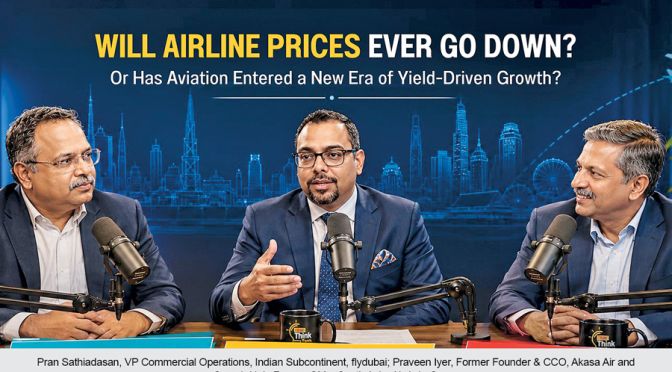
Lower ATF prices have revived an old question across India’s travel trade: if fuel is cheaper, why aren’t airfares falling? At the 7th TRAVTALK ThinkTank, aviation veterans examined the economics behind airline pricing.
Nisha Verma
For years, airline pricing appeared relatively simple. Fuel prices went up, ticket prices followed. Fuel prices came down and travellers expected fares to soften. That dependency, however, has weakened considerably. Even as ATF prices have eased over the past few months, airfares have largely remained firm, prompting passengers to ask travel agents the same question repeatedly: Why are tickets still expensive? The answer, according to the panellists at the 7th TRAVTALK ThinkTank, lies in the transformation of the aviation business itself. Airlines today are no longer chasing passenger numbers at any cost. Instead, they are focusing on something that remained elusive for decades — sustainable profitability.
Suresh Nair, Former GM – South Asia, Air Asia Group, shares, “If the conditions get better, the fares will come down. Being an optimist, I would expect 12 months from now the competition to come back and normalcy to return.”
Praveen Iyer, Former Founder & CCO, Akasa Air, however, views the issue very differently. “They better not, because even at these fare levels — or even at the fare levels that were about 15 per cent lower in the last financial year — all the airlines lost money.” For him, cheaper tickets may please consumers in the short term but would weaken the industry’s financial health. “Given where the capacity is headed, there can be correction in the fares, but it’s not going to be good for the industry.”
Pran Sathiadasan, VP – Commercial Operations, Indian Subcontinent, flydubai, believes the debate is beyond fares. “I don’t believe airline pricing has entered a permanently high-fare era. What has changed is that airlines have become more disciplined. In mature markets, profitability and yield drive pricing decisions.” However, India is unique because it keeps adding millions of first-time flyers. “We still have a nation to serve. There are new flyers being added every day.”
He suggested that it is the era of smarter pricing. “The future will not be about cheap fares versus expensive fares. It will be more about intelligent pricing that simultaneously maximises profitability and stimulates new demand.”
Don’t chase volume, chase viability
Iyer claimed that airlines spent years measuring success through one metric — volume. “Between 2005 and 2019, passenger growth recorded a CAGR of almost 16 to 17 per cent. Capacity growth was similar. Post-COVID, the CAGR between 2019 and 2025 was about four per cent,” he added. Despite record aircraft orders, capacity has not kept pace with the demand. “Before COVID, India domestic had close to 3,200 departures a day. Today we are operating around 3,000,” he underlined. The reasons are well known — aircraft delivery delays, engine shortages, and maintenance challenges — but Iyer believes another factor is equally important. “Airlines have rationalised capacity by saying, ‘Let’s sacrifice utilisation. Let’s not fly recklessly. Let’s make sure that when we fly from point A to point B, we at least recover cash,” shared Iyer.
Lower fuel prices may reduce one element of airline costs, but they cannot offset the impact of constrained capacity when demand continues to outstrip supply. He highlighted, “People want to travel and enjoy more. They don’t necessarily want to preserve cash. The upper middle-class segment is growing north of 35 per cent year-on-year. Gen Z likes to travel quite a bit and loves posting and using social media. Eventually, price is a reflection of demand versus supply.”
LCC revolution is a game changer
However, Nair reminded that before the arrival of low-cost carriers, airline fares in India were largely fixed. “Having seen aviation come up in the country from the 1990s, for a long time, it was just fixed pricing. Only when Air Deccan came around 2003, that dynamic pricing made its entry,” he recalled. For Nair, the success of the low-cost model was built on one simple principle. “The LCCs had this belief that the lower the prices, the higher the demand. That is how they work. LCCs normally come in with cost-plus pricing — what the cost of that operation is, plus some margin of profit,” he explained. Reminiscing his AirAsia days, he explained how dramatically the market reacted when the airline entered India, sharing, “When AirAsia started flights, on many sectors we were much lower than the legacy carriers. Even when the prices stabilised, we were 20 to 30 per cent lower than the legacy pricing.” The response from competitors was immediate. “Within a short time, the legacy carriers dropped their prices to our levels. Many of my travel agent friends called and said, ‘Suresh, what’s the difference? Yours is Rs. 28,000, Malaysian is Rs.30,000. They give baggage and food. Why did they come down from Rs.36,000?’ Because we had come down to Rs.28,000.”
IndiGo: benchmark for industry pricing
Nair claimed, “There is no way you can price above IndiGo in the economy sector. Whether it is Air India, any full-service carrier, or earlier Vistara, they could not price themselves above IndiGo in the economy sector, because it had become the standard that the lowcost airlines established. In fact, IndiGo, on many sectors where they have a monopoly, can charge a premium as well,” he pointed out. Even so, competition continues to prevent airlines from increasing fares. “It is always a question of demand and supply. Because of competition, it will be very difficult for any airline simply to increase prices to get profitability,” he commented.
Can another ultra-LCC work in India?
This led to another question: Could India once again support an airline charging significantly less than IndiGo? Nair doesn’t believe so. “The cost of operations in India remains the same. There is no LCC airport in the country. Everything — the landing, the parking — is the same. Fuel prices remain the same.”
Airlines also cannot compromise on safety or reliability. “To maintain that quality of service, you need the best aircraft, operate on time, get the best crew and safety. The cost structure cannot come below that,” he highlighted. Iyer agreed that aggressive discounting would simply recreate the financial problems the industry has spent years trying to solve. “Let’s face it. The industry lost Rs.30,000 crore,” he quipped. Explaining why current fares are still not generating adequate returns, he said, “IndiGo had a top line of Rs.85,000 crore and controls about 60 per cent of the market. We are talking about a top line of Rs.175,000 crore and losing Rs.30,000 crore. That’s a loss margin of close to 18 per cent. Even if pricing goes up by 18 per cent, at best the industry is going to break even.” However, he elaborated, “There could be instances where airlines price themselves below IndiGo, but it’s not sustainable. This will lead to airlines burn and drain themselves in a matter of time.”
Fleet strategy to influence fares
The discussion led to fleet planning, and Sathiadasan argued that Indian airlines may need to rethink the type of aircraft they deploy rather than simply ordering more aircraft. “We are ordering hundreds, even thousands, of aircraft, but most are in the 180-plusseat category.” He quoted a lesson he learnt from Nair: “Fre-quency drives demand.”
This means that instead of operating a handful of large aircraft, airlines could stimulate markets by flying smaller aircraft more often. “Rather than operating two 180-seat aircraft, one in the morning and one in the evening, if you operate five 120-seat aircraft, you’ll probably generate more demand while optimising your yields. The minute you deploy a 180-seater with only a 50 or 60 per cent load factor, you are immediately under pressure to lower prices,” he illustrated. Fleet financing presents another challenge. “Saleand- leaseback works perfectly fine if there is some semblance of sanity in the rupee-dollar valuation. For every one-rupee increase against the US dollar, IndiGo, with its fleet size, runs up a bill of around Rs.900 crore in a quarter,” he underlined.
Premium is profitable
Sathiadasan believes airlines have recognised that India may remain a pricesensitive market, but travellers want more than just the cheapest ticket. “We forget there is a segment in India that wants a little more creature comfort. Even today, the number of people who miss Kingfisher and Jet Airways is huge,” he highlighted. Flydubai experienced a similar evolution. “We introduced business class very quickly. There was a need to become a full-service carrier because otherwise you are neither here nor there,” shared Sathiadasan.
He believes IndiGo’s premium product reflects the same trend. “The move with IndiGo Stretch has been precisely about identifying that market of people who want a premium product. It is the front of the aircraft that brings in profitability,” he reiterated.
Trade central to aviation story
Discussing about the travel trade, Iyer shared, “There has been a lot of maturity in the trade in the post-COVID era versus the pre- COVID era.” He believes travel advisors today understand that sustainable airlines are ultimately good for the entire ecosystem. “The B2Bs and the B2Cs all talk about increasing fares. They have understood that a low price doesn’t necessarily mean it’s good for the industry. Having lost a lot of money with quite a few airlines closing down, they have realised that it may help in the short term, but in the long term it may hurt the business,” remarked Iyer. However, he claimed the revenue model for travel agencies is changing, and called domestic, a commodity business. As airlines move away from traditional commission structures, agencies will increasingly demonstrate value beyond simply issuing\ tickets. “It becomes a customer-pay model.” For international travel, though, the role of advisors remains stronger. “There is a lot of segment selling that happens. The agent knows more about flydubai or Emirates than Akasa, especially in tier II and tier III cities, because they have been selling those airlines for such a long time.” Sathiadasan agreed that travel agents will continue to play an important role, particularly for international travel, saying, “International travellers still need visas, hotels and many other services that people may not know. They still want an intermediary to handle that. With airlines coming to a zerocommission level, agents will charge passengers a convenience fee to make up their margins.”
Loyalty is key
Iyer said that loyalty programmes are unavoidable for airlines. “When 95 per cent of the market is sitting on a loyalty programme, it’s not about whether I like it or not. I have to participate. Nine out of 10 don’t like it, but they will continue to fly by virtue of the loyalty and the benefits that they get.” Nair, however, cautioned airlines against making loyalty programmes financially burdensome. Drawing on his experience with Cathay Pacific, he observed, “Marco Polo Club, the loyalty programme by Cathay, never gave free tickets.”
AI will not replace advisors
On Artificial Intelligence, the panel acknowledged that its full impact is still unfolding. Nair adopted a balanced view, saying, “It’s a complex situation where we do not know what AI can ultimately deliver. How much agents will be able to use AI travel booking systems — we’ll have to wait and see.”
The verdict
As airlines focus on building sustainable businesses rather than chasing market share, the role of the travel professional also needs to evolve — from ticket seller to trusted advisor. Iyer summed up the industry’s new reality saying, “One of the reasons why we have had more failures than successes in this country is because we have priced below cost. We must not hope for prices to come down. They are only going to go up, and they better go up, because that’s the only way this industry will become sustainable.”