

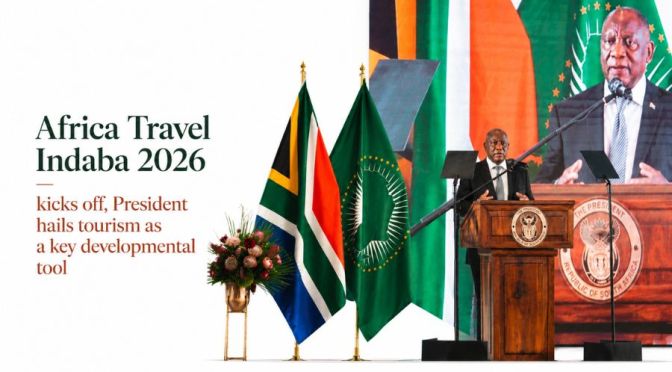
Tourism’s role in driving economic recovery, employment, and regional integration took centre stage at Africa’s Travel Indaba 2026, with South African President Cyril Ramaphosa calling for stronger collaboration to unlock the continent’s tourism potential.
Speaking at the opening of Africa’s Travel Indaba 2026, Ramaphosa highlighted tourism as a key developmental tool capable of accelerating economic growth and job creation across Africa.
“South Africa welcomed 10.5 million international visitors last year, a clear sign that the world is rediscovering our country with renewed enthusiasm,” Ramaphosa said during his address.
Tourism linked to economic recovery and regional growth
The President noted that before the Covid-19 pandemic, tourism contributed nearly 7 per cent to Africa’s GDP, underlining the sector’s importance to the continent’s economy. He stressed the need for African nations to strengthen tourism infrastructure and improve regional connectivity to stimulate further growth.
Ramaphosa identified several areas requiring attention, including airport infrastructure, road networks, visa facilitation, and air connectivity across African markets.
“We need to improve airports, roads, visa-free travel, and lower airfares to encourage intra-African tourism,” he said.
The remarks reflect a growing continental push towards making regional travel more accessible, particularly as African tourism boards and governments seek to strengthen intra-African movement alongside international arrivals.
Africa’s Travel Indaba returns focus to continental tourism
Africa’s Travel Indaba remains one of the continent’s largest tourism trade platforms, bringing together tourism boards, buyers, hospitality stakeholders, and travel businesses from across Africa and international markets.
The 2026 edition comes at a time when several African destinations are witnessing renewed international interest, supported by improving air connectivity, investment in hospitality infrastructure, and growing demand for experiential and cultural tourism.
Ramaphosa’s address also reinforced tourism’s role beyond visitor arrivals, positioning the sector as a catalyst for broader economic participation, small business growth, and employment generation across the continent.
As destinations across Africa continue rebuilding and repositioning post-pandemic, the focus on regional mobility and collaborative tourism development is expected to remain central to long-term growth strategies.

Rahul Bhadana is a digital editor at TravTalk with experience spanning multiple content niches, with a strong focus on travel trade journalism and digital publishing. A graduate of Delhi University, his work covers editorial writing, content strategy and platform-led storytelling, supporting TravTalk’s digital growth and industry engagement. A technology enthusiast, he enjoys films, poetry and exploring new ideas across media and culture.