

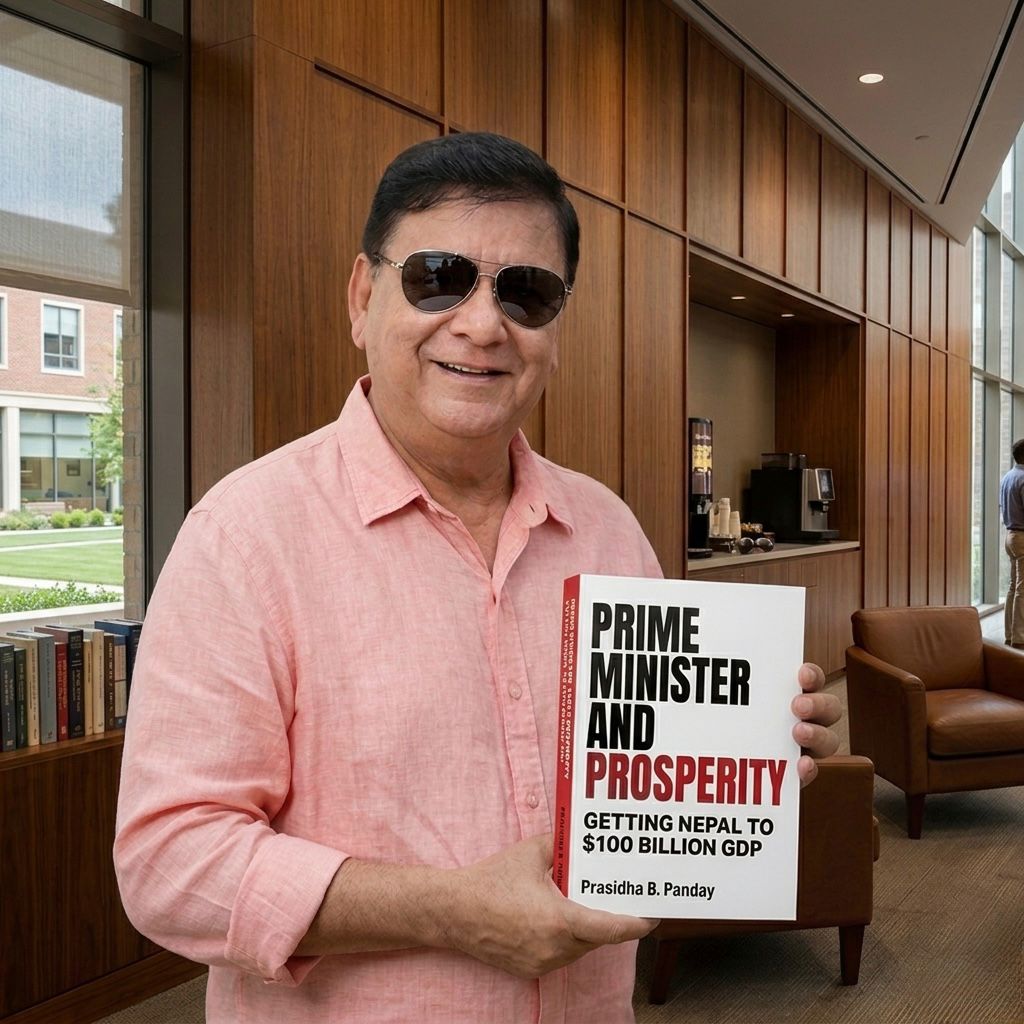
Chairman of Nepal’s premier hotel group, Shangrila Hospitality Group, Prasidha Bahadur Panday, released his first book – Prime Minister And Prosperity – Getting Nepal to $100 billion GDP – last week. In the wake of the devastating flash-floods that hit the Himalayan nation this week, the agenda of the book becomes all the more relevant.
Nepal needs a fundamental shift in the way it approaches economic development, moving away from isolated projects and ministry-wise planning towards a centrally coordinated national framework capable of transforming the Himalayan nation into a USD 100-billion economy within the next 10 to 12 years, says Prasidha Bahadur Panday, Chairman of Shangrila Hospitality Group.
Panday, whose first book Prime Minister and Prosperity – Getting Nepal to $100 Billion GDP has recently hit the shelves of major bookstores and distributors in Kathmandu, believes the proposition assumes greater relevance as Nepal grapples with the devastating impact of recurring natural calamities, including the latest flash floods that have caused extensive loss of life and damage to infrastructure.
The book, according to Panday, is less about identifying individual projects and more about establishing the governance architecture, delivery mechanisms, monitoring systems and investment framework required to execute a comprehensive economic transformation programme. The central proposition is that Nepal should develop an overarching economic and social Master Plan with a single point of central coordination under the Prime Minister, while keeping individual ministries as executing agencies.
Such a framework, he believes, would bring together the country’s key economic opportunities—including hydropower, tourism, agriculture, infrastructure and other industries—under a common vision, with measurable GDP-linked outcomes and clearly defined timelines.
Nepal has had multiple development plans and thousands of individual projects over the years, but they have largely operated within sectoral and ministerial silos. The absence of a mechanism for effective coordination across ministries has often resulted in delays, political bottlenecks and fragmented implementation. Panday believes central coordination should not be interpreted as an attempt to empower a central authority, but as a mechanism to ensure that different ministries and agencies work towards a common national objective.
For international investors, he argues, the primary requirement is not a further explanation of Nepal’s inherent potential. The country’s hydropower, tourism and other economic opportunities are already widely understood. What investors need is clarity on the government’s vision, the legal and regulatory framework, the investment mechanism and, most importantly, confidence that commitments will be delivered within a defined timeframe.
A credible accountability mechanism at the highest level of government could therefore become the foundation for attracting significantly larger volumes of domestic and foreign capital.
The latest flash floods have once again highlighted the vulnerability of Nepal’s infrastructure and tourism economy to natural disasters. Panday believes, however, that disasters should be treated as recurring shocks that a stronger and better planned economy must be capable of absorbing rather than as events that repeatedly push the country back to the starting point.
With a USD 100-billion economic capacity as the overarching objective, the financial resources, investment interest, expertise and institutional capacity required to rebuild damaged infrastructure could be mobilised much faster. What may have taken decades under the existing fragmented approach could potentially be addressed within two or three years through a coordinated programme, he believes.
More importantly, Panday places greater emphasis on preventing the loss of human lives than on protecting physical assets. Roads, bridges and buildings can be rebuilt, whereas lives cannot be recovered. Nepal therefore needs to invest in robust early-warning mechanisms that can detect floods, glacial and river-related threats and other natural hazards well in advance.
Among the sectors that could help Nepal accelerate its journey towards a USD 100-billion economy, tourism assumes particular importance in Panday’s framework. He sees tourism as a faster economic multiplier for Nepal than several other sectors and believes the country needs to move beyond the conventional approach of developing individual tourism projects.
Pokhara, in particular, has the potential to be developed as a major integrated tourism hub on the lines of destinations such as Bali and Phuket. Rather than treating individual hotels, attractions, airports and tourism products as separate projects, the entire city and its surrounding ecosystem could be planned as an integrated tourism platform.
Such a hub could bring together hotels, tourism products, aviation connectivity, financial services and supporting infrastructure, with appropriate investment incentives and financing mechanisms. The multiplier effect generated by such a concentrated tourism ecosystem could extend well beyond the destination itself.
Airports, for instance, could be developed as aviation, logistics and commercial hubs capable of connecting the large markets of India and China with Nepal and creating new regional economic opportunities.
Panday also believes that Nepal needs to rethink its approach to Nepal Airlines. Instead of simply looking at partial privatisation or the sale of government equity, the country should undertake a comprehensive valuation of the airline’s assets and commercial rights and explore ways of monetising the entire platform.
A properly structured investment proposition could enable an international player to deploy substantial additional aircraft over a five- to ten-year period, transforming Nepal Airlines into a much larger regional carrier.
Panday also makes an attempt to delve into success stories of economies in the region like Singapore, Malaysia, Vietnam, Thailand, etc. in his book on how improving the delivery mechanism of government can fundamentally change the economics of a country.
The transformation of Singapore’s trade and port-related processes through TradeNet technology demonstrated how government procedures could be streamlined, he said. The lesson for Nepal, he believes, is not simply to replicate a particular technology but to adopt the underlying philosophy of government delivery
Panday’s proposed framework also places GDP at the centre of performance measurement. Individual projects, he argues, should be assessed not merely on whether they are completed but on the economic and social value they generate.
The USD 100-billion target is consequently presented not simply as a number but as a measure around which the country can align its development priorities, investment strategy and governance delivery.
Prime Minister and Prosperity – Getting Nepal to $100 Billion GDP is Panday’s first book. Rather than positioning it as a definitive policy document, he sees it as an attempt to initiate a wider conversation around how Nepal can rethink its economic development model.
His second book, Lost Horizon Reclaimed, is set to be officially launched, in October, together with the opening of the most luxurious resort property of the group, InterContinental Resort Pokhara.