
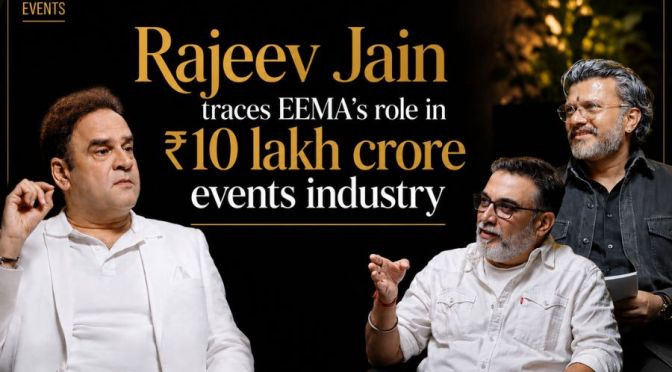
India’s events industry is poised for its next phase of growth, driven by stronger government collaboration, policy reforms, and wedding tourism opportunities, according to Rajeev Jain. Reflecting on more than three decades in the business, he also highlighted EEMA’s contribution to shaping the country’s organised events ecosystem.
Rajeev Jain, Founder & Director, Rashi Entertainment, has reflected on the evolution of India’s events industry, crediting the Event and Entertainment Management Association (EEMA) with helping build a stronger, more organised ecosystem while advocating policies that support industry growth.
Drawing on his 33-year entrepreneurial journey, Jain said EEMA has played a pivotal role in bringing the events industry together and creating a unified platform to engage with governments and policymakers on issues affecting the sector.
One such initiative, he said, involved working with industry stakeholders to secure reduced rentals at government venues, including Jawaharlal Nehru Stadium and Indira Gandhi Indoor Stadium. Jain said discussions with Sports Minister Mansukh Mandaviya and Delhi Minister Kapil Mishra resulted in a 50 per cent reduction in venue rentals, making large-scale concerts more commercially viable and supporting efforts to position Delhi as India’s creative capital.
Wedding tourism offers the next growth opportunity
Jain identified wedding tourism as one of the biggest opportunities for India’s events industry and said he has been engaging with Gajendra Singh Shekhawat, Minister of Tourism, Government of India, over the past three years to position India as a preferred destination for international weddings.
He said India’s heritage palaces, beaches, monuments, temples, wellness retreats, and cultural diversity offer significant potential to attract overseas wedding business.
“Countries around the world are competing to host destination weddings. India has everything needed to become a global wedding destination. We should encourage families from across the world to celebrate their weddings here,” he said.
Jain also urged industry members to work closely with governments and policymakers, saying sustained engagement is essential to achieving reforms that benefit the sector.
Industry enters a new growth phase
Reflecting on the future, Jain said India’s events economy has the potential to become a ₹10 lakh crore industry, supported by stronger collaboration between entrepreneurs, industry associations, and government institutions.
He also spoke about the importance of giving back to society through initiatives such as Vivah Utsav, a mass wedding programme, alongside building sustainable businesses.
Naveen Gupta, Co-founder, Spalba, said the initiative aims to document the journeys of leaders who have shaped India’s hospitality and events industry.
“Our effort is to preserve the stories of the people who built this industry. Every conversation is an opportunity to understand not just what they created, but how they thought, how they navigated challenges, and what future generations can learn from their journeys,” Gupta said.
According to Spalba, documenting such industry experiences forms part of its broader vision of creating both the technology and knowledge infrastructure to support the future growth of India’s hospitality and events ecosystem.
Watch the complete conversation: