

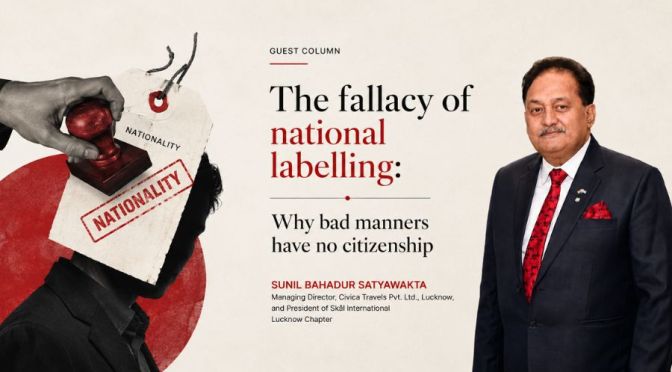
In recent times, social media platforms and travel forums have seen a surge in criticism directed at Indian travellers. Accusations ranging from a lack of civic sense in public spaces to clearing out breakfast buffets to pack lunch, or pocketing hotel souvenirs, are frequently weaponised under a single, sweeping generalisation. But to label an entire population of over 1.4 billion people based on the public indiscretions of a few is not only intellectually lazy — it is fundamentally flawed.
Behaviour reflects individual mentality, upbringing, and personal ethics. It has absolutely nothing to do with the passport a person holds.
The myth of the “perfect” Western or global traveller
The narrative that behavioural issues are exclusive to developing nations or specific ethnicities falls apart under the slightest scrutiny. Bad travel etiquette is a global phenomenon:
European Tourists: Major European historic cities like Amsterdam, Venice, and Rome have frequently had to introduce strict laws, fines, and anti-tourism campaigns specifically targeting rowdy, intoxicated, and destructive behaviour from Western European travellers.
Global Incidents: From tourists carving their initials into the ancient Roman Colosseum to travellers trespassing on sacred sites in Southeast Asia or damaging fragile ecosystems for the sake of a selfie, the perpetrators hail from every corner of the globe.
The Buffet Dilemma: The urge to “maximise value” at hotels — whether by hoarding food or hoarding pool chairs at 6 am — is a well-documented behaviour among tourists worldwide, regardless of their financial or national background.
Yet, when a Western tourist behaves poorly, the internet labels them “a bad tourist”. When an Indian traveller does the same, the internet labels them “an Indian”. This double standard is where the narrative becomes toxic.
The high price of individual actions
The real tragedy of this generalisation is that innocent nationals always end up paying the price for the actions of a few entitled or unaware individuals.
Most Indian travellers — much like the vast majority of Chinese, European, or American travellers — are respectful, curious, and eager to explore the world while respecting local cultures. They tip well, follow rules, and leave positive impressions. However, their quiet decency is easily overshadowed by a single viral video of someone misbehaving.
Culture vs. character
While it is true that different cultures have different norms regarding personal space, volume, and public interaction, there is a clear line between cultural adjustment and sheer entitlement. The latter is a human trait, not a national one.
Instead of weaponising bad behaviour to fuel xenophobic stereotypes, global discourse needs to shift towards addressing individual accountability. A bad tourist is just that: a bad tourist. It is time to retire the lazy habit of tagging an entire nationality for the sins of a few and recognise that civic sense — or the lack thereof — is a reflection of character, not country.


Rahul Bhadana is a digital editor at TravTalk with experience spanning multiple content niches, with a strong focus on travel trade journalism and digital publishing. A graduate of Delhi University, his work covers editorial writing, content strategy and platform-led storytelling, supporting TravTalk’s digital growth and industry engagement. A technology enthusiast, he enjoys films, poetry and exploring new ideas across media and culture.