

A visa application can look straightforward on paper: a passport, financial documents, photographs, travel details, a few forms. But anyone who has actually gone through the process knows it’s rarely that simple.
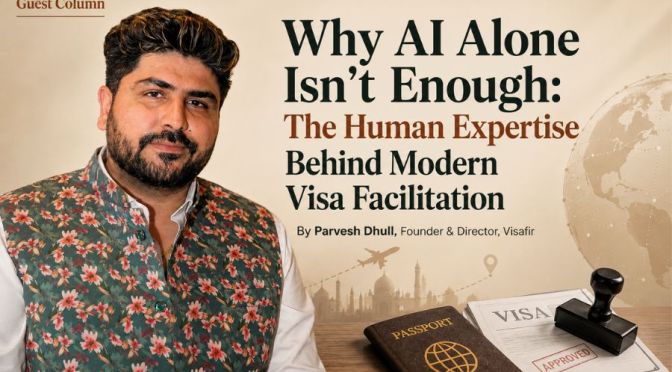
By Parvesh Dhull, Founder & Director, Visafir
Requirements differ across destinations. Documents need to be complete and consistent with one another. A small gap in information can trigger a cascade of follow-up questions, and a requirement that’s routine for one applicant may need real attention for another.
This is where technology is beginning to change visa facilitation.
Artificial intelligence is increasingly used to organise visa documentation, flag missing information, cross-check data, and support preliminary document checks. For travellers, that can mean a faster, more structured visa application process.
But it raises a fair question: can AI alone provide the judgement and confidence a visa application actually requires?
The answer probably isn’t a choice between technology and people. It’s in bringing the two together.
AI Can Identify a Problem. A Human Can Understand It.
AI’s biggest strength in visa processing is handling large volumes of information quickly, comparing documents, flagging inconsistencies, catching missing pieces, and checking whether requirements appear to be met. That alone removes a meaningful amount of the repetitive work involved in visa document verification.
But a flagged issue isn’t always a simple issue.
A document might look incomplete because of an oversight, or because the applicant’s circumstances genuinely call for more information. A discrepancy might need clarification rather than correction. A checklist can tell you what’s missing — it can’t always tell you why it matters for this application.
That’s where human expertise still counts.
An experienced professional can look at an application as a whole, ask the right follow-up questions, and recognise circumstances that don’t fit a predefined pattern. Put simply: AI can raise a flag. A person decides what the flag actually means.
The Future Isn’t AI Versus Humans
Much of the conversation around AI defaults to replacement — which jobs disappear, which processes get fully automated, how much human involvement can be stripped out.
For visa processing, that’s probably the wrong question. The better one is: how does AI make human expertise more effective?
There’s little point asking a trained professional to spend hours on repetitive verification that software can complete in seconds. But there’s real risk in assuming every application can be reduced to a set of automated rules.
A layered model makes more sense. AI runs the initial check, organises the information, and surfaces potential gaps. A human expert then reviews those findings, weighs the application in context, and adds a second layer of scrutiny before it moves forward — AI and human verification working in sequence rather than in competition. The two roles are different, but they complement each other.
Why a Second Layer of Review Matters
Visa applications aren’t like most routine digital transactions — the outcome directly affects someone’s plans. A family may have spent months planning a trip. Someone may be flying out to see relatives. A business traveller may have a meeting riding on the outcome.
In situations like these, “the system checked it” doesn’t always feel like enough. People want to know a person actually looked at their application.
That’s what a second layer of review provides: technology runs a systematic check, and a trained professional independently examines the details for anything that might have been missed, misread, or in need of clarification. This isn’t about distrusting AI — it’s about recognising that automation and judgement solve different halves of the same problem.
Human Expertise Is Becoming the Safety Net
There’s a common assumption that adding humans back into a process automatically slows it down. That’s not necessarily true once repetitive tasks are automated.
AI handles much of the initial legwork — sorting information, checking documents, flagging gaps — freeing professionals to spend their time where experience actually adds value. That changes what the human role looks like. It’s no longer about processing paperwork; it’s about being the layer of judgement and accountability that steps in when an application doesn’t fit the standard pattern.
Automation shouldn’t exist to remove people simply because it’s possible. It should exist to remove unnecessary manual work while keeping human oversight exactly where it matters most.
Trust Will Shape the Next Phase
As AI-powered visa services become more common, simply calling a platform “AI-enabled” will start to mean less. Travellers will ask more practical questions: Who’s checking this? What happens if something doesn’t fit the usual process? Can someone explain why a particular document is needed? Is there a person who can step in when things are unclear?
These are the questions that will increasingly shape how people choose visa facilitation services.
Technology can make visa documentation and application review faster, more organised, easier to manage. But human professionals remain essential for interpretation, judgement, and reassurance.
The future of visa facilitation probably won’t belong to AI alone. It will belong to systems where technology provides speed and consistency, and human expertise provides context and confidence.
That balance may end up being the real measure of progress — not processing more applications with less human involvement, but building a process that’s faster where technology helps, more carefully reviewed where judgement is needed, and, in the end, more reassuring for the person whose journey depends on getting it right.
Disclaimer: This is a guest column, and the views and opinions expressed are those of the author. They do not necessarily reflect the views or opinions of TRAVTALK. TRAVTALK may or may not agree with the views expressed in this column.