
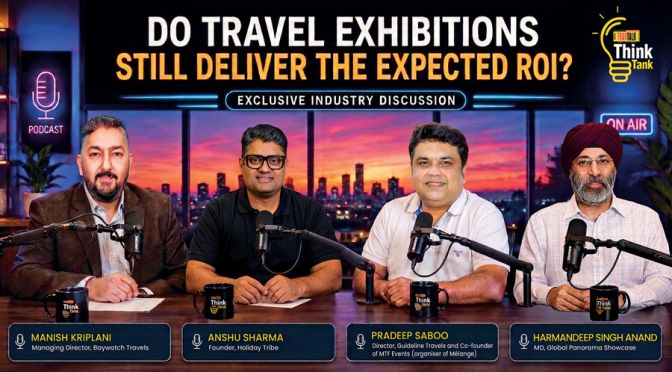
Travel exhibitions may not be losing relevance, but they are facing an urgent need to evolve — that was the clear message from event organisers and buyers who took part in the latest edition of TRAVTALK ThinkTank.
TT Bureau
For years, the travel industry has debated whether exhibitions continue to justify the time, effort, and investment they demand. For thousands of Indian travel agents and tour operators, the question is even more practical. Is spending two or three days away from the office translating into better supplier relationships, more competitive products, and ultimately more bookings? TRAVTALK’s latest ThinkTank attempted to answer that question, but uncovered something much more significant. The panel, comprising exhibition organisers and outbound travel buyers, did not question whether exhibitions should continue to exist. Instead, the discussion quickly shifted towards a far more pressing issue. How can exhibitions become more valuable for exhibitors, buyers, and organisers alike?
Surprisingly, despite representing different sides of the industry, the panel found itself agreeing on far more than disagreeing. The consensus was unmistakable. Travel exhibitions remain indispensable, but their future depends on becoming more focused, more measurable, and far more intelligent in the way they connect businesses.
Beyond survival
One of the strongest takeaways from the discussion was that exhibitions are no longer fighting for survival. Face-to-face meetings continue to occupy a unique position within the travel industry, something that virtual meetings have never been able to replace.
Harmandeep Singh Anand, Managing Director, Global Panorama Showcase (GPS), believes exhibitions continue to play an essential role because relationships in travel are still built through personal interaction. “Face-to-face connect is always a must. The confidence gets built when you meet people.”
Anshu Sharma, Founder, Holiday Tribe, agreed that exhibitions remain one of the few platforms capable of creating trust at scale. “The exhibition still matters a lot in terms of efficiency, trust, scale, and timing.” That shared belief set the tone for the rest of the conversation.
Bigger no more better
Perhaps the biggest shift highlighted during the discussion was the industry’s changing definition of success. For decades, organisers proudly promoted visitor numbers, square metres sold, and expanding exhibition halls. The panel argued that these metrics no longer tell the full story.
Pradeep Saboo, Director, Guideline Travels and Co-founder of MTF Events (organiser of Mélange), who has experienced exhibitions as an exhibitor, buyer, and organiser, believes growth without quality serves little purpose. “Growing a show is very easy. Maintaining the quality of the exhibitor as well as the buyer is of paramount importance.”
Rather than allowing unlimited participation, Saboo explained that his exhibition deliberately limits suppliers from individual destinations to maintain diversity across the show floor. That philosophy reflects a wider shift taking place across the industry. The objective is no longer to host the biggest exhibition. It is to organise the most productive one.
Quality, not quantity
The most revealing insights came from the buyer side of the table. Buyers are no longer attending exhibitions to collect brochures or exchange visiting cards. They are looking for suppliers who can help them grow new destinations, improve margins, and offer experiences that differentiate them from competitors. Sharma and Manish Kriplani, Managing Director, Baywatch Travels, admitted that they no longer judge exhibitions by their size. Instead, they ask a much simpler question. Will attending help them discover new business opportunities?
For Sharma, the answer begins with one factor. “The single criteria will be the quality of people who are attending.” He explained that the value of attending any exhibition depends entirely on whether the right suppliers are present and whether those suppliers align with the company’s future business plans.
Kriplani echoed a similar thought. Unlike many buyers, he attends international travel shows more often than several domestic events. His reason had nothing to do with geography. It had everything to do with meeting quality. “Everything is so perfectly organised. Every meeting… you have your 15 minutes.” He contrasted that experience with exhibitions where conversations are interrupted by walk-ins or overlapping meetings.
For buyers whose schedules are already filled with supplier visits, destination presentations, and international events, every hour spent at an exhibition must deliver genuine value.
ROI rethink
Perhaps the most important question raised during the discussion was also the hardest to answer. How exactly should Return on Investment (ROI) be measured? The panel unanimously agreed that measuring success purely through footfall is no longer sufficient. Sharma pointed out that the industry still lacks a common benchmark. “There is no third-party benchmarking available to calculate my ROI on attending that show.” Without measurable outcomes, organisers often celebrate attendance numbers while exhibitors struggle to quantify business generated. Instead of asking how many people walked through the door, organisers increasingly need to answer a different question. How many meaningful business conversations took place?
Exhibition fatigue
Many travel companies today receive invitations to multiple exhibitions, destination roadshows, hotel showcases, and airline events every month. Choosing where to invest time has become almost as important as deciding whether to attend at all.
Every speaker acknowledged that the calendar has become increasingly crowded. New shows continue entering the market while regional associations launch their own events across India. The result is a growing sense of exhibition fatigue.
Sharma noted that increasing frequency creates new challenges for both buyers and exhibitors. Suppliers often choose one city over another, making it difficult for buyers to meet everyone they wish to connect with. The issue, he argued, is not that exhibitions are unnecessary. It is that the industry has yet to evolve alongside the outbound travel business itself.
Anand acknowledged the same challenge. “Yes, the fatigue sets in because there are too many trade shows.” However, he also believes the industry continues to grow, bringing new travel entrepreneurs into the market and creating fresh opportunities for exhibitions that can educate and connect emerging businesses. For him, the answer is not fewer exhibitions. It is better exhibitions.
Technology will decide
If there was one subject that united every panellist, it was technology. The panel viewed technology as the tool that could finally solve the biggest weakness of traditional exhibitions, the lack of meaningful engagement before and after the event.
Sharma described post-event follow-up as one of the industry’s biggest missed opportunities. “This is one of the biggest missing links. Most suppliers are in the process of collecting visiting cards. By the end of any show, you might be one of the thousand cards for the supplier. Even if you had a productive conversation, the follow-ups are not happening.”
Rather than relying on stacks of business cards and generic email campaigns, Sharma believes AI can help exhibitors identify genuine prospects, organise conversations, and prioritise the buyers most likely to generate business. “There is a dire need for technology which enables suppliers to keep a follow-up with the right people.”
Anand agreed that technology will fundamentally change how exhibitions deliver value. “The way to connect is digital. That is the way forward.” He believes AI will strengthen rather than replace face-to-face meetings by extending conversations before, during, and after every event. “AI will make people connected for a much longer period of time rather than over a shorter period.”
Smart matchmaking
The traditional free-flow exhibition model came under repeated scrutiny. Sharma argued that buyers should be able to identify relevant suppliers before arriving at an event instead of relying on chance encounters. “There is no sort of tech involved wherein I can see who is attending and schedule my calendar better,” he observed while discussing the limitations of several current exhibition formats. Meeting 20 carefully selected suppliers is infinitely more valuable than spending an entire day walking exhibition aisles hoping to discover the right partner. Kriplani shared a similar perspective. Before attending any exhibition, he studies the exhibitor list, researches suppliers, and builds a detailed meeting schedule. “I actually spend a lot of time studying each one of them… there are some people I want to meet, then there are people I already know, and then there are close friends I don’t want to miss.”
Today’s buyers arrive prepared. Exhibitions, therefore, need to evolve from networking opportunities into carefully curated business marketplaces.
Buyer screening
If technology was one pillar of the future, buyer quality emerged as the other. Throughout the discussion, organisers repeatedly stressed that attracting more visitors is meaningless unless the right visitors are attending. Saboo explained that organisers have a responsibility to protect the quality of both exhibitors and buyers.
“We go to the extent of actually screening the social media of the person.” The objective, he explained, is not to restrict participation but to ensure exhibitors spend their time meeting professionals who are capable of generating business. That philosophy stood in sharp contrast to traditional exhibitions where visitor numbers often become the primary success metric.
Room for more exhibitions
One of the more surprising moments came when the conversation turned towards the growing number of travel exhibitions across India. Despite acknowledging exhibition fatigue, Saboo rejected the idea that India has reached the saturation point. “There is space for more exhibitions to happen.” His reasoning was straightforward. “India’s outbound market continues to expand, while domestic tourism remains one of the world’s largest travel economies.” However, he also issued a warning. “Only the best organised and focused approach shows will remain.”
A consensus
Everyone accepted that exhibitions remain essential. Everyone agreed that face-to-face meetings continue to build trust faster than virtual conversations. Everyone accepted that technology must become central to future exhibitions. And perhaps most importantly, everyone concluded that success can no longer be measured by footfall alone.